
Table of Contents
- Why Most 'Indestructible' Dog Toys Fail
- Understanding Your Dog's Chewing Profile
- Best Materials for Long-Lasting Pet Toys
- Durable Chew Toys for Aggressive Chewers: What Actually Holds Up
- How to Manage Aggressive Chewing Behaviors
- Are Tear Resistant Toys Worth It? The Cost Breakdown
- Frequently Asked Questions
Last Updated: September 21, 2026
Why Most 'Indestructible' Dog Toys Fail
Walk down any pet aisle and you'll see the same promise printed on packaging: indestructible. Then your dog shreds it in twenty minutes. This gap between marketing and reality is exactly why so many owners start asking whether are tear resistant toys worth it at all, or whether they're just paying more for the same disappointment. At PetzGlow, we hear this frustration constantly from owners of power chewers.

The Truth Behind Indestructible Marketing Claims
Indestructible dog toys are products marketed as chew-proof, but the label carries no regulated definition and no testing requirement behind it. A toy earns that word from a copywriter, not a lab.
Understanding Your Dog's Chewing Profile
The right toy for your dog depends less on breed and more on chewing style. Owners who match toys to a chewing profile report far fewer destroyed toys than those who buy by size alone.
Most dogs fall into one of three profiles:
- Power chewer: Applies sustained jaw pressure, often destroys plush toys within minutes, targets seams and corners first
- Moderate chewer: Chews regularly but loses interest before a toy fails, responds well to a mix of textures
- Teething or anxious chewer: Chews for comfort rather than destruction, often during teething or periods of stress
The Psychology of Destructive Chewing
Destructive chewing is rarely about defiance. It's usually about unmet needs: boredom, excess energy, or a natural prey drive that has nowhere to go. A dog left alone for nine hours with one toy will find something to destroy, and it may not be the toy you left out.

Best Materials for Long-Lasting Pet Toys
Natural rubber, ballistic nylon, and reinforced-stitch fabric consistently outlast other materials for heavy chewers. But durability is only half the equation. Because dogs swallow tiny particles as toys wear down, what a toy is made of matters as much as how long it lasts.
| Material | Best For | Weakness | Typical Lifespan |
|---|---|---|---|
| Natural rubber | Power chewers, fetch | Can be punctured by determined chewers | Months |
| Ballistic nylon | Tug-of-war, fetch | Seams fail first | Weeks to months |
| Reinforced-stitch fabric | Moderate chewers, teething | Not for heavy solo chewing | Weeks |
| Plush | Light chewers, comfort | Shredded quickly by power chewers | Days |
Material Toxicity and Safety Standards
Non-toxic and BPA-free labeling matters because dogs ingest small particles as toys wear down. There is no single federal standard governing pet toy materials in the way children's toys are regulated, so labeling varies widely between brands.
How to Read a Toy Label Like a Safety Inspector
Most owners scan for the word "durable" and move on. A closer read tells you more. Here is what to check before a toy goes in your cart:
- Material name, not just category. "Natural rubber" and "TPR rubber" behave differently. Natural rubber tends to have more give; some synthetic blends harden as they age and can crack into sharp edges.
- Country-of-origin and lot codes. These let a manufacturer trace a defect. A toy with no manufacturing information is harder to hold accountable if something goes wrong.
- Explicit non-toxic language. "Non-toxic" on its own is vague. Look for phrases like "food-grade," "phthalate-free," or "BPA-free" that name the specific concern being addressed.
- Scent test. A strong chemical or plastic smell is a red flag. Rubber should smell like rubber, not solvent.
- Small-part warnings. Squeakers, bells, and glued-on eyes are the first things a determined chewer removes. If a toy's appeal depends on a detachable part, treat it as a supervised-play item only.
Why 'Indestructible' and 'Non-Toxic' Rarely Appear Together
The hardest toys are often the most heavily processed. Dense composites and hard plastics that resist a power chewer's jaw are frequently the same materials most likely to chip, crack, or shed micro-particles over time. That trade-off is rarely printed on the package.
Rinse rubber and nylon toys with warm water after outdoor play. Dirt trapped in surface texture wears down the material faster and can harbor bacteria your dog ingests.
Durable Chew Toys for Aggressive Chewers: What Actually Holds Up
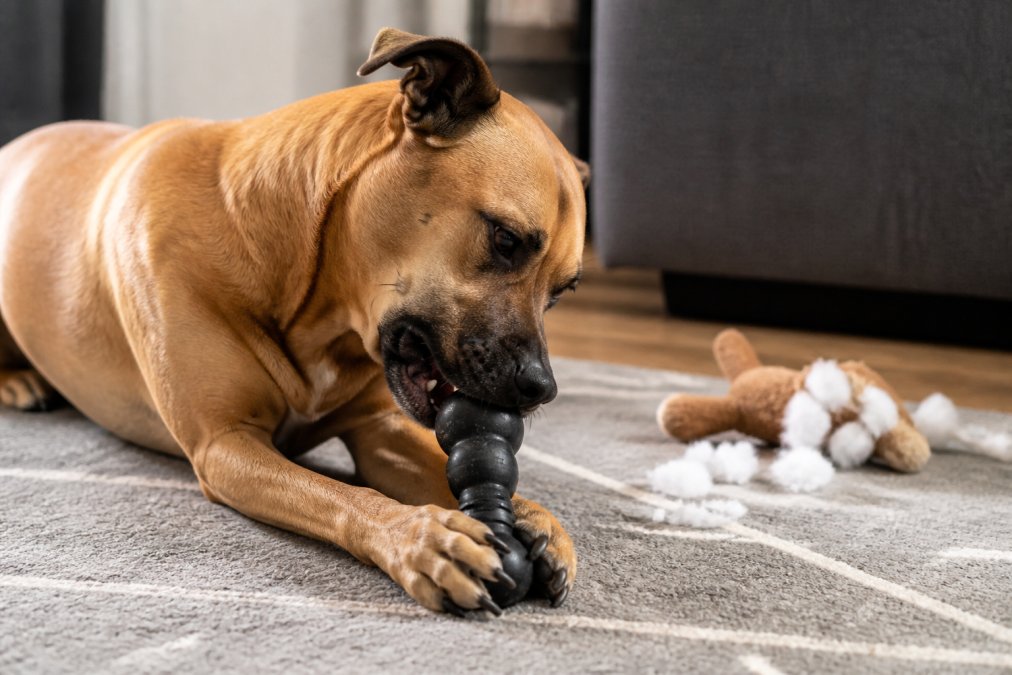
The toys that survive aggressive chewers share three traits: dense material, no small detachable parts, and a size matched to the dog's mouth. Everything else is secondary.
How to Manage Aggressive Chewing Behaviors
Managing aggressive chewing starts with redirecting the behavior, not suppressing it. Chewing is natural; the goal is teaching your dog what's appropriate to chew.
A practical routine looks like this:
- Provide one dedicated chew toy during alone time
- Schedule 20-30 minutes of active play or walking daily
- Rotate toys every few days to maintain novelty
- Remove and replace any toy showing cracks, tears, or exposed stuffing
- Redirect chewing to an approved toy the moment it starts on furniture
Toy Rotation and Maintenance Protocols
Toy rotation is the cheapest durability upgrade available. Keeping three or four toys in circulation and swapping them weekly makes each one feel new, which reduces the focused destruction that comes from boredom.
A toy that lasts six months with proper rotation beats three toys destroyed in two months without it. Maintenance extends lifespan more than material choice alone.
Are Tear Resistant Toys Worth It? The Cost Breakdown
Tear resistant toys are worth it for power chewers and multi-dog households, where replacement costs add up fast. For light chewers, a cheaper plush toy may last just as long. The trick is running the math on your own dog instead of trusting a generic recommendation.
A Simple Cost-Per-Week Formula
Cost per week = Toy price ÷ Weeks the toy lasts
| Scenario | Cheaper Toy | Tear-Resistant Toy |
|---|---|---|
| Power chewer, daily chewing | Replaced weekly | Lasts months |
| Moderate chewer | Lasts weeks | Lasts months |
| Light chewer | Lasts months | Lasts longer than needed |
| Multi-dog household | Constant replacement | Shared, rotated use |
The Hidden Costs Most Owners Forget
Sticker price is only part of the ledger. Three overlooked factors change the math:
- Replacement trips. Every destroyed toy means another errand, another shipping fee, or another impulse buy at checkout. Time and gas count.
- Safety incidents. A toy that fails mid-chew can mean a vet visit for a swallowed fragment. Even one obstruction scare can outweigh years of toy savings.
- Behavioral cost. A dog that shreds toys out of boredom often redirects that energy to furniture, shoes, or baseboards. The real cost of a cheap toy isn't the toy, it's what gets destroyed alongside it.
Where Tear-Resistant Toys Fall Short
If your dog nibbles occasionally, you're paying a premium for durability you'll never test. Buy the cheaper option and save the difference. The same logic applies to puppies in the teething stage: a rock-hard "indestructible" toy can damage developing teeth, so a softer, less expensive teething toy is often the smarter buy even if it wears out faster.
Maintenance Changes the Math
A toy that lasts six months with proper rotation beats three toys destroyed in two months without it. Rotating three or four toys and swapping them weekly keeps each one novel, which reduces the focused destruction that comes from boredom. Washing fabric toys by hand and rinsing rubber toys with warm water also extends usable life by removing grit that accelerates wear.
Run the cost-per-week formula on your own dog before buying. If a tear-resistant toy lasts at least three times longer than your current option, it usually wins on price, and it wins on safety every time.
Frequently Asked Questions
Do tear-resistant toys actually last longer for aggressive chewers?
They often do, but it depends on the material and your dog's chew intensity. Toys made from natural rubber or reinforced stitching typically withstand power chewers longer than standard plush toys. However, no toy is truly indestructible. Even tear-resistant toys need regular inspection for cracks or loose pieces. The key is matching the toy's material density to your dog's specific chewing style, not just buying the toughest label on the shelf.
What materials make a dog toy truly tear-resistant?
Natural rubber, ballistic nylon, and heavy-duty durable fabric with reinforced stitching are the most common tear-resistant materials. Natural rubber offers flexibility and puncture resistance, while ballistic nylon resists tearing from sharp teeth. Look for toys labeled non-toxic and BPA-free, especially if your dog ingests small pieces. Material density matters too: thicker rubber lasts longer but may be too hard for senior dogs or puppies with sensitive gums.
How can I tell if a toy is safe for my dog's chewing style?
Check the toy's material and construction before buying. Avoid hard plastic or rubber that does not give at all, as these can crack teeth. For aggressive chewers, choose toys with some flexibility that still resist punctures. Inspect toys weekly for cracks, missing pieces, or exposed squeakers. If you can dent the toy with your fingernail but it springs back, it is usually a good match. Always supervise new toys until you know how your dog interacts with them.
Are there any dog toys that are truly indestructible?
No toy is truly indestructible. Even the toughest natural rubber or ballistic nylon toys will eventually wear down, especially with power chewers. Marketing claims of indestructibility set unrealistic expectations. Instead, look for toys described as tear-resistant or durable, and plan on a replacement cycle. A toy that lasts weeks instead of days is a win. Always remove a toy once it shows signs of damage to prevent choking hazards or swallowing risk.
The real challenge isn't finding a toy that survives forever, it's finding one matched to how your dog actually chews. PetzGlow builds durable, tear-resistant chew toys for exactly that purpose, including natural rubber toys for aggressive chewers, reinforced-stitch sets for tug-of-war, and teething toys sized for smaller mouths. Every option is designed to hold up, clean easily, and keep your dog engaged. Shop now and give your power chewer a toy that earns its place.