
Table of Contents
- Why Noise Is the Hidden Trigger in Dog Grooming
- The Real Benefits of Quiet Dog Grooming Tools
- Quiet Dog Clippers vs. Traditional Clippers: What Changes
- How to Get a Dog Used to Clippers With a Desensitization Plan
- Dog Grooming for Nervous Dogs: Matching Tools to Temperament
- Tips for Stress-Free Dog Grooming at Home
- When Quiet Tools Are Not Enough
- Build a Calmer Grooming Kit With PetzGlow
- Frequently Asked Questions
Last Updated: October 20, 2026
Why Noise Is the Hidden Trigger in Dog Grooming
Most owners blame the clippers for a bad grooming session, but the real culprit is usually the sound. Quiet dog grooming starts with understanding that a buzzing motor hits a dog's ears very differently than ours.
At PetzGlow, we build grooming gear for owners who want calm sessions, not chaos, so we think about noise before blades. This guide covers the benefits of quiet dog grooming tools plus a step-by-step plan for getting a nervous dog comfortable with clippers.
How Dogs Hear Grooming Tools Differently
Dogs pick up frequencies and sudden sounds that human ears barely register. A clipper that sounds like a mild hum to you can read as a sharp, unfamiliar buzz to a dog standing inches away.
Vibration travels through the blade and into the skin, too. Many dogs react to that sensation before they react to the sound.
The Fear Response Behind the Buzzing Sound
A frightened dog gives you signals long before it growls: lip licking, yawning, tucked tail, stiff legs, and sudden stillness. Once the fear response kicks in, the dog stops cooperating and starts protecting itself, and that is when nicks and stressed owners happen.
The cycle is predictable. Noise triggers anxiety, anxiety triggers movement, movement makes a clean trim impossible, and the next session starts with a dog that remembers the last one. Breaking that loop is the whole point of quieter equipment.
The Real Benefits of Quiet Dog Grooming Tools
The payoff from low-noise clippers shows up in two places: how the dog behaves and how the finished trim looks.
Calmer Sessions and Fewer Stress Signals
A dog that is not bracing against a loud motor stays looser, so the blade glides instead of catching, and you can work through sensitive areas like the paws, face, and belly without a fight.
Motor noise and vibration are two separate stressors: noise triggers a startle response, while vibration travels through the blade into the skin and triggers touch avoidance.
How to Tell a Quieter Tool Is Actually Helping
Track these observable indicators across several sessions:
- Session duration. Time from first tool-on to final brush-off. A calmer dog usually means a shorter session, not a longer one.
- Number of breaks. Count how many times you have to stop to let the dog settle. Fewer breaks is a good sign.
- Avoidance behaviors. Watch for lip licking, yawning, tucked tail, stiff legs, sudden stillness, and pulling away when the tool comes near. Note how many you see per session.
If a quieter tool is working, session duration, breaks, avoidance behaviors, and recovery time should all drop over two to four weeks.
Better Trimming Results and Less Mess
Steady dogs get better haircuts. When the dog holds still, the blade follows your line, the coat comes out even, and you avoid the choppy patches that come from stopping and restarting mid-stroke.
Quiet operation pairs well with a proper grooming table: a non-slip surface and secure loop keep the dog planted.
Quiet Dog Clippers vs. Traditional Clippers: What Changes
Quiet dog clippers trade raw power for control. Traditional clippers run louder and vibrate harder, which is fine for a bombproof dog and miserable for a nervous one.
What "Quiet" Actually Means
"Silent" is a marketing word, not a measurement. Sound is measured in decibels (dB), and the number depends on distance, blade load, and room surfaces.
Ask for the measurement conditions, not just the number. If a listing gives a dB figure without distance and load, treat it as a rough comparison at best. The same applies to vibration, there is no standard consumer rating, so compare side-by-side feel in your hand and against your dog's coat.
Side-by-Side on the Factors That Decide a Session
| Factor | Quiet Clippers | Traditional Clippers |
|---|---|---|
| Sound character | Lower, steadier hum; less sharp startle | Louder, sharper buzz; harder startle |
| Vibration | Dampened housing, rubber-mounted blade | More transfer to the blade and skin |
| Best for | Nervous dogs, sensitive areas, finishing | Heavy coats, bulk removal, high volume |
| Session feel | Calmer, slower pace | Faster but more stressful |
| Coat care | Good for finishing and touch-ups | Strong for bulk removal |
| Blade heat | Often lower RPM, but check after 10-15 minutes | Can heat faster under load |
| Battery life | Cordless convenience, but runtime varies widely | Corded models run indefinitely |
| Trimming speed | Slower feed rate on dense coat | Faster feed rate on dense coat |
The honest limitation: some quiet models are not built for thick, double coats or heavy matting. If your dog has a dense undercoat, you may need a more powerful tool for bulk work and a quiet one for finishing, faces, and paws.
Quiet Tools Are Not Interchangeable
"Quiet grooming tools" covers several categories, and each has its own benefits and limits:
- Clippers. The biggest noise and vibration source. Quiet models help most, but lower RPM can mean slower feed through dense coat. Check blade heat after 10-15 minutes of continuous use; a hot blade is a burn risk regardless of sound level.
- Nail trimmers and grinders. A grinder is often quieter than a clipper but produces a high-pitched whir that some dogs dislike more than a clipper's hum. Manual trimmers are silent but require more skill to avoid quicking.
- Dryers. Often the loudest tool in the kit. Look for adjustable speed and temperature so you can run low and slow for sensitive dogs; high-velocity dryers are effective but rarely quiet.
Maintenance and Performance Trade-offs
Lower noise does not mean lower performance, but it changes the maintenance picture. Quieter clippers often run at lower RPM, which reduces blade heat but slows the feed rate on dense coat. Clean blades and light oil between sessions keep drag and noise down. Cordless models add battery runtime as a limiting factor, check the rated runtime and whether the battery is replaceable.
Pet Shaving Dog Hair Clipper Haircut For Cats And Dogs →
How to Get a Dog Used to Clippers With a Desensitization Plan
Getting a dog used to clippers is a gradual process, not a single session. Pair the tool with good things until the dog stops treating it as a threat, and plan several short sessions over a week or two.
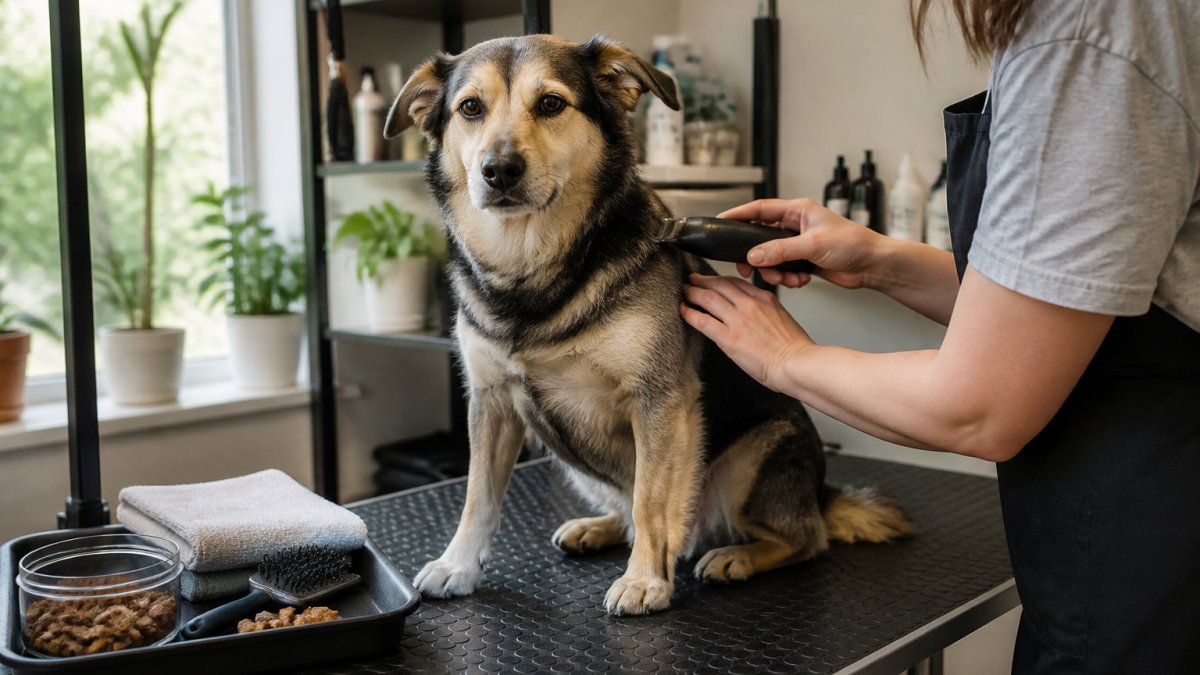
- Let the dog investigate the tool while it is off. Place the clipper on the floor, let the dog sniff it, and reward curiosity with a treat.
- Turn it on across the room. Run the motor a few feet away, reward calm behavior, and switch it off before the dog gets uneasy.
- Move closer over several sessions. Bring the running clipper nearer each time, always pairing it with treats and stopping at the first sign of stress.
- Touch the tool to the body while off. Rest the clipper against the shoulder, then the back, then a leg, rewarding each calm moment.
- Run it against the coat without cutting. Let the dog feel the vibration with the blade guarded, then reward.
- Trim a small, easy area first. Start with a low-stress spot like the back, not the face or paws.
- Keep sessions short. End on a calm note, even if you only trimmed a small patch.
Step six matters more than the rest. Most owners rush to the face and paws because that is where the mess is, and that is exactly where a nervous dog panics.
Dog Grooming for Nervous Dogs: Matching Tools to Temperament
Dog grooming for nervous dogs is a matching problem. The right tool for a trembling rescue is not the right tool for a confident working breed.
Match the tool to temperament and coat together. A sound-sensitive dog needs the quietest option you can find, with a dampened motor and cordless design.
For sensitive areas like the face, paws, and belly, scissors often beat clippers outright. A grooming scissors kit with rounded safety tips and a silencer between the handles reduces the metal-on-metal click that spooks dogs, and it gives you control in spots where a clipper feels too aggressive.
Tips for Stress-Free Dog Grooming at Home
Stress-free dog grooming at home comes down to preparation and pacing. Set up the space before the dog arrives, keep sessions short, and build in breaks.
- Groom at the same time and place so the routine becomes predictable.
- Exercise first. A tired dog settles faster on the table.
- Use a stable, non-slip surface. A dog that feels secure stops scrambling.
A grooming table with a secure loop and non-slip rubber top does more for stress than most owners expect: the dog stops slipping and the whole session gets shorter.
When Quiet Tools Are Not Enough
Quiet tools solve a lot, but they are not a cure-all.
Talk to your veterinarian about severe anxiety before you push through; a vet can recommend a behavior plan that makes grooming safer for the dog and for you.
The other limit is coat type. Heavy matting needs to be removed carefully, and a quiet clipper may stall on dense fur.
Build a Calmer Grooming Kit With PetzGlow
You know the noise is the problem, but the gear you already own is working against you. Replacing the loudest tools in your kit is the fastest way to a calmer dog and a cleaner trim, so start there.
We built PetzGlow for exactly this. Our Pet Shaving Dog Hair Clipper runs on dual-purpose charging or power, so there is no cord dragging across the table, and at $29.99 it is an easy upgrade for a nervous dog. Pair it with our Professional 4-in-1 Grooming Scissors Kit, which has a silencer between the handles to cut the metal click that spooks dogs, and rounded safety tips for faces and paws.

For a stable, non-slip surface, our PawHut 42" Grooming Table holds up to 100kg with two loops and a rubber top, so your dog stays planted while you work. Add the Pet Nail Grinder with USB Charging for quieter nail care, and finish with our adjustable-speed Dog Dryer at low speed for sensitive dogs.


Quiet dog grooming is not about one tool. It is about removing every loud, jarring trigger from the session so your dog can relax and you can finish the job.
Frequently Asked Questions
Do quiet dog clippers help reduce grooming stress?
They can help, but the tool is only part of the picture. A lower noise level and less vibration remove two common triggers, so many dogs stay calmer during quiet dog grooming sessions. That said, a dog that has already learned to fear clippers may still tense up at the sight of them. Pair quiet tools with slow introductions, short sessions, and treats so the dog connects the clipper with something positive rather than just a softer sound.
What should I look for in low-noise dog clippers?
Look at the motor type, the vibration level, and whether the clipper is cordless. A cordless pet trimmer removes the hum of a cord and gives you more freedom around tricky spots like paws and ears. Check the weight too, since a heavy clipper tires your hand and makes you less steady. Blades should be sharp enough to glide through fur without pulling, because snagging causes more flinching than sound alone.
How can I help my dog get used to grooming clippers?
Start with the clipper turned off. Let your dog sniff it, then reward calm behavior. Turn it on in another room so the sound is distant, and gradually move closer over several days. Touch the clipper to the body without trimming, then run it over a safe area for a few seconds. Keep sessions under five minutes at first, and stop before your dog shows stress. A gradual desensitization plan works better than forcing a full groom on day one.
Are quiet grooming tools enough for very nervous dogs?
Not always. Quiet tools remove a major trigger, but fear can also come from restraint, unfamiliar surfaces, or past bad experiences. For dogs with a strong fear response, combine quiet equipment with a non-slip grooming table, a secure loop, and short sessions. Some dogs do better with a groomer who handles anxious pets. If your dog panics, freezes, or snaps, talk to your vet before continuing at home.