
Table of Contents
- Why Your Dog Panics at Grooming Time
- What You'll Need Before You Start
- Desensitization Techniques for Dog Grooming That Actually Work
- How to Trim Dog Nails Without Stress
- Best Calming Aids for Dog Grooming: What Helps and What Doesn't
- Handling Sensitive Areas: Paws, Ears, Face, and Tail
- Post-Grooming Recovery and Breed-Specific Triggers
- Conclusion
- Frequently Asked Questions
Last Updated: September 18, 2026
Why Your Dog Panics at Grooming Time
Learning how to groom anxious dog at home starts with one truth: your dog is not stubborn. Grooming anxiety is a fear response that builds over time and can be unlearned with patience.
Dogs panic at grooming time for clear reasons:
- Past pain: A nicked nail or pulled knot teaches a dog that grooming hurts.
- Loud tools: Clippers and dryers sound like predators to sensitive ears.
- Restraint: Being held still feels like being trapped.
- Novelty: New smells, tables, and hands trigger alarm.
The fix is gradual, reward-based training, not force.
Reading Stress Signals Before They Escalate
Dogs tell you they are scared long before they snap. Watch for lip licking, yawning when not tired, whale eye, a tucked tail, trembling, panting, drooling, freezing, or hiding. Once a dog passes into full panic, learning stops, end the session and try again later.
How Trigger Stacking Turns Small Fears Into Big Reactions
Trigger stacking is when small stresses pile up until a dog explodes. A single nail trim might be fine, but add a bath, a loud dryer, and a stranger, and the same dog may snap. Break grooming into single tasks, one day nails, another day brushing, to stay under its stress threshold.
What You'll Need Before You Start
Gather your tools before your dog enters the room. Fumbling for supplies mid-session raises tension.
What you'll need:
- Non-slip mat or towel for the floor or table
- Rounded scissors for face and paw touch-ups
- Nail clippers with a safety guard
- Slicker brush with rounded tips
- High-value treats cut into pea-sized pieces
- Calming chews (if your vet approves)
- Towel for cleanup
| Tool | Purpose | Frequency |
|---|---|---|
| Slicker brush | Removes loose fur, detangles | 2-3 times weekly |
| Nail clipper | Trims nails to safe length | Every 3-4 weeks |
| Flea comb | Checks for pests, lifts debris | Weekly |
| Finger toothbrush | Cleans teeth gently | Daily or every other day |
Desensitization Techniques for Dog Grooming That Actually Work
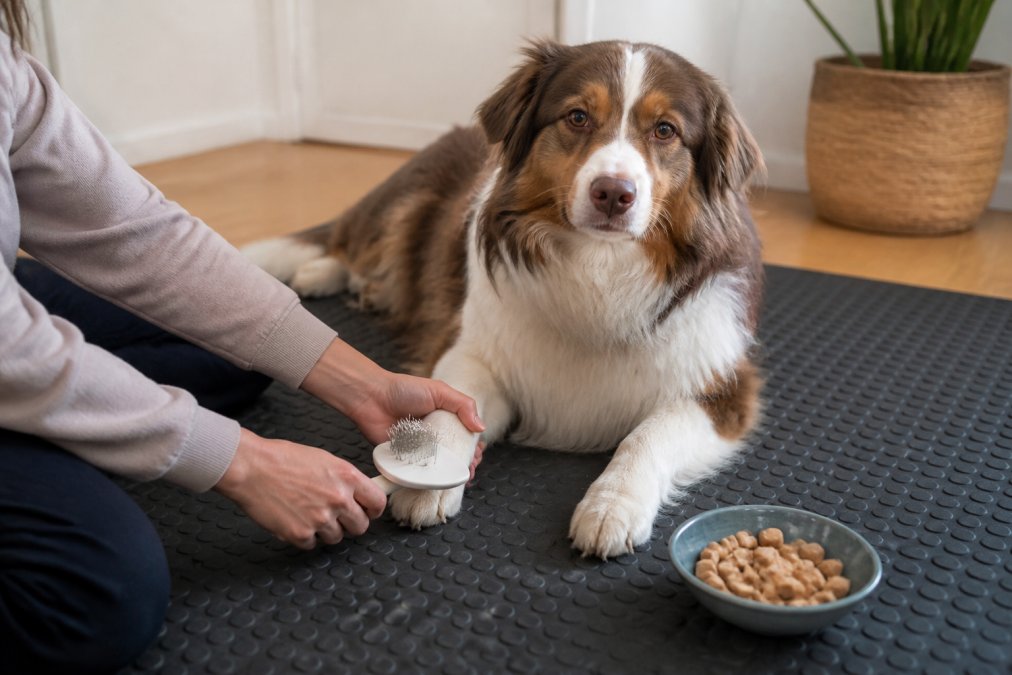
Desensitization means introducing a feared object or action in tiny, non-scary doses until your dog stops reacting. Pair it with counter-conditioning: follow every exposure with something good, like a treat.
Pairing Tools With High-Value Treats
High-value treats are foods your dog rarely gets, like small bits of chicken or cheese. Follow this order:
- Show the tool, treat.
- Touch the tool to your dog's shoulder, treat.
- Turn the tool on across the room, treat.
- Touch the running tool to the shoulder, treat.
- Move toward the paws, ears, and face over several sessions.
How to Trim Dog Nails Without Stress
Trimming nails is the hardest part of grooming for most owners. Aim for one nail at a time, not a full set.
How to trim dog nails without stress:
- Touch each paw for a few seconds daily for a week. Treat after each touch.
- Press the pad gently to extend one nail. Treat. Release.
- Clip one nail only. Treat generously. Stop.
- Repeat the next day with a different nail.
- Use a file to smooth sharp edges if your dog tolerates it.
Best Calming Aids for Dog Grooming: What Helps and What Doesn't
Most guides lump every calming product into one bucket, but a pheromone diffuser and a prescription anti-anxiety medication work on completely different timelines and severities. Here are four tiers, plus a rule for when to move up.
Tier 1: Environmental Aids (Mild Anxiety)
These change the room, not the dog, and work best for dogs that tremble or lip-lick but still take treats.
- Non-slip mats and tub liners. Sliding is a top fear trigger. A textured mat or rubberized tub liner removes the sensation of losing footing, the cheapest fix and often the most effective.
- Pheromone products. Dog-appeasing pheromone (DAP) comes as diffusers, sprays, and collars and mimics a nursing mother's pheromone. It takes 15-30 minutes to build up, so plug it in before the session. Evidence is mixed.
- White noise or a fan. A fan or white-noise machine at moderate volume masks the high-frequency whine of clippers without adding stress.
- Low, slow vocal tone. A descending, drawn-out tone signals safety; high-pitched, fast chatter reads as alarm.
Tier 2: Consumable Aids (Mild to Moderate Anxiety)
These are ingested and take time to act, daily supplements built up over one to two weeks, not rescue remedies.
- L-theanine. An amino acid in green tea. Common canine doses are roughly 1-2 mg per pound of body weight, but confirm with your veterinarian. Onset is roughly 30-60 minutes.
- Chamomile and valerian root. Found in many calming chews; effects are mild and cumulative.
- CBD. Dosing is unregulated, purity varies, and clinical evidence in dogs is limited. If you try it, buy from a brand publishing third-party lab results and tell your vet.
- Adaptil-style collars. Slow-release pheromone collars worn for weeks; better for baseline anxiety than a single session.
Tier 3: Behavioral Aids (Moderate Anxiety)
These are training-based and cost nothing but time.
- Body wraps. A snug cloth wrap applies gentle pressure to the torso. Some dogs settle immediately; others hate it, so test it on a calm day first.
- Mat training. Teach your dog that a specific mat means treats and calm, then groom on the mat to borrow that association.
- Stationing. Reward your dog for holding still on a designated spot for increasing durations, 5 seconds, then 10, then 30, before any tool appears.
Tier 4: Veterinary Intervention (Severe Anxiety)
This is the tier most articles skip, and the one that matters most for dogs that panic, bite, or injure themselves.
- Your dog has bitten or attempted to bite during grooming.
- Your dog injures itself trying to escape (broken nails, cut gums, scraped paws).
- Your dog stops eating or hides for hours after a grooming attempt.
- Two weeks of consistent desensitization produce no measurable improvement.
- Your dog is so fearful that it will not take a high-value treat in the grooming room.
What a veterinarian can offer:
- Pain screening. Undiagnosed arthritis, dental pain, or ear infections can make a dog reactive to touch; treating the pain often resolves the "anxiety."
- Situational anti-anxiety medication. Drugs such as trazodone or gabapentin are prescribed for short-term, event-specific use, reducing the fear response so the dog can still learn during desensitization.
- Daily anti-anxiety medication. For generalized anxiety, daily medication (such as fluoxetine or clomipramine) can lower the baseline enough that training works.
- Referral to a veterinary behaviorist. A board-certified veterinary behaviorist is the highest level of expertise for severe cases.
The Decision Rule
If your dog still takes treats and recovers within minutes of a session ending, stay in Tier 1 or 2 and keep training. If it stops taking treats, hides afterward, or escalates to snapping, skip straight to Tier 4. Every panic episode makes the next one more likely.
Handling Sensitive Areas: Paws, Ears, Face, and Tail
Paws, ears, face, and tail have more nerve endings and are touched less in daily life. Work on one area per session, using calming touch: slow, light strokes with the back of your hand first.
- Paws: Touch between the pads. Reward. Build to holding a paw for three seconds.
- Ears: Wipe the outer flap only. Never push anything into the ear canal.
- Face: Use rounded scissors. Trim away from the eyes. Keep sessions under 30 seconds.
- Tail: Brush with the grain. Avoid tugging tangles.
Post-Grooming Recovery and Breed-Specific Triggers
Most guides stop when the tools go down. That is a mistake: the 30 minutes after a session are when your dog's nervous system decides whether grooming was a threat or an annoyance. Get recovery wrong and you undo a week of desensitization work; get it right and each session compounds.
7pcs Pet Grooming Kit, Self-Cleaning →
The Post-Grooming Recovery Protocol
The goal is to bring your dog's arousal back to baseline fast. Cortisol can stay elevated for hours after a frightening event, which is why a dog that seemed fine during grooming may still be jumpy at dinner.
Minutes 0-1: Immediate release
- End every session on a win, even if that win is just one nail or ten seconds of brushing.
- Give a high-value treat within 10 seconds of the last tool touching your dog. The treat must follow the end of the session, not the struggle.
- Remove all tools from sight before the treat. A dog that sees clippers while eating learns that treats predict clippers.
Minutes 1-5: Decompression
- Let your dog shake off, a full-body shake is a stress-release behavior you should never interrupt.
- Open the door or gate so your dog can leave the grooming area. A dog that stays is telling you the session went well; one that bolts is telling you it was too much.
- Do not cuddle a dog that is still panting or trembling; comfort at peak arousal can reinforce the state. Wait for the first sign of settling, a sigh, a soft eye, a lowered tail, then offer calm, quiet praise.
Minutes 5-30: Reset
- Offer fresh water; stress panting dehydrates.
- Provide a quiet space away from other pets and children, an open crate, a bed in a low-traffic room, or a favorite corner.
- Skip vigorous play, training, or walks for at least 30 minutes; elevated cortisol makes a dog more reactive to everything.
- Do not bathe or re-groom to "fix" a bad result. A half-finished nail trim is fine; a second session the same day is not.
After 30 minutes: Log the session
Write down three things while they are fresh:
- What tool or body part triggered the first stress signal.
- How many seconds or repetitions you got through before stopping.
- How long it took your dog to return to normal behavior.
Breed-Specific and Coat-Type Triggers
Anxiety triggers are not universal. Coat type, skull shape, and breed history all change which parts of grooming are hardest. Tailor your approach to the dog in front of you.
Double-coated breeds (Huskies, Golden Retrievers, German Shepherds, Akitas)
- These dogs have a soft undercoat and longer guard coat. They need 10-15 minutes of brushing per side but generally tolerate it well.
- The trigger is usually the dryer and clippers, not the brush, forced air and vibration feel strange against a dense coat.
- Never shave a double-coated dog to "reduce" grooming; it can permanently damage coat regrowth and remove needed insulation.
- Use an undercoat rake during shedding season, then a slicker brush to finish.
Wire-haired and terrier breeds (Schnauzers, Westies, Airedales)
- These coats need hand-stripping or clipping every 6-8 weeks; clipping changes coat texture over time.
- The trigger is often restraint around the face and legs, since these breeds are typically stripped while standing.
- Build tolerance for standing still on a non-slip surface before introducing the clipper.
Curly and continuously growing coats (Poodles, Bichons, Doodles)
- These coats mat easily and need daily or every-other-day line brushing.
- The trigger is tugging on mats, a single painful detangle can set back weeks of work.
- Use detangling spray and work mats out with your fingers, then a wide-tooth comb, then a slicker. Never cut a mat out with scissors near the skin.
Smooth-coated breeds (Beagles, Boxers, Dachshunds)
- Minimal brushing needed, a rubber curry or hound glove once a week is enough.
- The trigger is usually nail trims and ear cleaning, because these dogs get less daily handling than long-haired breeds.
- Handle paws and ears daily from puppyhood, even if you never need to brush.
Flat-faced (brachycephalic) breeds (Pugs, French Bulldogs, Boston Terriers, Bulldogs)
- Facial folds need daily wiping with a damp cloth or pet-safe wipe, then drying, moisture in folds causes infections.
- The trigger is anything near the face or airway. These dogs already work harder to breathe, so restraint around the neck or muzzle is genuinely distressing.
- Never use a grooming noose or loop on a flat-faced dog; use a flat harness or free-stand the dog.
- Baths are harder because water near the nose can obstruct breathing. Use a damp cloth instead when possible.
Herding breeds (Border Collies, Australian Shepherds, Collies)
- These dogs are often tactile-sensitive, disliking touch on the paws, hindquarters, or tail.
- They are also highly sound-sensitive, so clipper noise and dryer whine are common triggers.
- Counter-conditioning works especially well here because they are food-motivated and trainable.
Giant breeds (Great Danes, Newfoundlands, Saint Bernards)
- The trigger is often height and instability. A dog that feels unsteady on a table will not tolerate grooming.
- Groom on the floor on a non-slip mat, or use a low, stable table with a rubberized surface and no noose.
A note on mixed breeds:
Conclusion
To groom anxious dog takes weeks, not one session. Start with stress signals, build trust through desensitization, and handle one small task at a time. PetzGlow makes that easier with professional-grade tools built for calm, quiet sessions: a self-cleaning slicker brush with rounded tips, stainless steel nail clippers, and a full 7-piece kit covering brushing, nails, and teeth.

Frequently Asked Questions
What can I do if my dog is too anxious to get groomed?
Start with desensitization away from the grooming table. Let your dog sniff the brush, clippers, and nail trimmer while you feed high-value treats. Pair each tool with something good, then slowly add touch and sound. Keep sessions to two or three minutes. If your dog still panics after several weeks of gradual exposure, talk to your veterinarian about whether calming aids or a professional behavior plan is the right next step.
How do you desensitize a dog to grooming tools?
Introduce one tool at a time. Turn on low-vibration clippers across the room, reward calm behavior, and move closer over multiple sessions. Touch the tool to a neutral body area like the shoulder before approaching sensitive spots. Use counter-conditioning: every time the tool appears, a treat follows. This changes how your dog feels about the tool, not just how they act. Short, frequent handling sessions work better than one long session.
Can I use calming treats for dog grooming?
Calming chews with ingredients like L-theanine or chamomile can take the edge off mild anxiety, but they are not a substitute for training. Give them 30 to 60 minutes before a session and pair them with desensitization work. For moderate to severe fear, ask your vet about prescription options. Always check with your veterinarian before starting any supplement, especially if your dog takes other medication.
How long should grooming sessions last for a fearful dog?
Keep sessions under five minutes at first, even if you only brush one leg. End on a calm note before your dog shows stress signals. As tolerance builds, add one or two minutes per week. A full groom may take several short sessions instead of one long one. This approach prevents trigger stacking and helps your dog stay under threshold, which is where real learning happens.