
Table of Contents
- Why Grooming Stresses Cats Out (And Why It Gets Worse)
- Step 1: Set Up a Calm Grooming Space Before You Touch the Brush
-
Step 2: How to Desensitize a Cat to Grooming Tools
- Phase 1: Tool on the Floor (Days 1-3)
- Phase 2: Tool Near the Body, No Contact (Days 4-7)
- Phase 3: One-Second Contact (Days 8-14)
- Phase 4: Real Grooming in Micro Sessions (Week 3+)
- The 5-Second Rule: Building Tolerance in Micro Sessions
- What Counts as a Treat (and What Does Not)
- How Long This Actually Takes
- Step 3: Restraint-Light Handling That Keeps Your Cat in Control
- Step 4: Best Grooming Tools for Nervous Cats
- Step 5: Shorten Sessions, Reward Often, and Know When to Stop
- Cat Grooming Anxiety Relief: Pheromones, Age Adjustments, and Trouble Spots
- Common Mistakes That Make Grooming Stress Worse
- Frequently Asked Questions
Last Updated: October 2, 2026
Why Grooming Stresses Cats Out (And Why It Gets Worse)
Cats are not small dogs, and treating them like one turns brushing into a wrestling match. At PetzGlow, owners tell us every week they dread nail trims and brushing. The good news: you can reduce grooming stress for cats with a few changes. This guide walks through seven calm steps, from reading feline behavior to choosing cat-friendly tools.

Cats are prey animals. A brush feels like a claw, a trimmer like a bite, and one bad session sticks in memory.
That is why it worsens: each stressful session raises the starting stress load for the next.
Reading Your Cat's Stress Signals Before They Escalate
Cats rarely go from calm to thrashing without warning. They send stress signals first, and most owners miss them.
Watch for these early behavioral cues:
- Flattened ears or ears turned sideways
- Tail twitching or a fast, whipping tail tip
- Dilated pupils even in normal light
- Skin rippling along the back
- A low, held-breath stillness
If you see any of these, stop. That is your cat saying "I am done."
Hissing and growling come next, then thrashing. By then the session is over whether you want it to be or not.
Step 1: Set Up a Calm Grooming Space Before You Touch the Brush
Pick one quiet spot and use it every time, a bathroom counter, low table, or nonslip mat on the floor.
Set the space up before your cat arrives:
- Close doors and block escape routes
- Lay down a nonslip surface so paws feel stable
- Put tools within arm's reach so you never turn away
- Use soft, indirect lighting
A cat secure on its feet is far less likely to panic; a cat sliding on a counter will scramble and remember the fear. Keep the room quiet, skip the TV and vacuum, and groom at the calmest time of day if your cat is noise-sensitive.
Step 2: How to Desensitize a Cat to Grooming Tools
Desensitization teaches your cat that the brush predicts treats, not stress, slowly, over days or weeks, without forcing contact. Counterconditioning is the partner skill: you change what the tool means, from "claw" to "chicken."
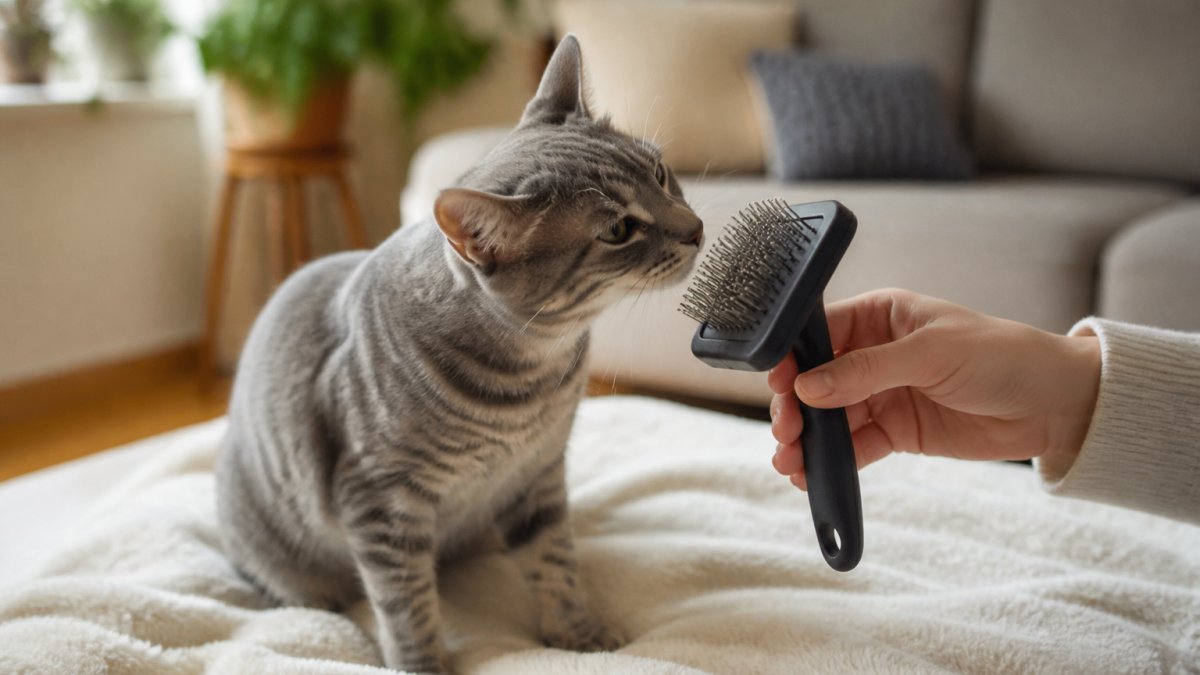
Below is a four-phase plan you can run over two to four weeks. Skip a phase if your cat is already comfortable; repeat one as long as needed.
Phase 1: Tool on the Floor (Days 1-3)
Put the brush, comb, or trimmer on the floor in your cat's hangout spot.
When your cat sniffs it, drop a treat nearby and walk away. You are building one association: tool present = food appears.
If your cat avoids the tool, move it closer to the food bowl over several days.
Phase 2: Tool Near the Body, No Contact (Days 4-7)
Pick up the tool, hold it a foot away, treat, put it down. Next repetition, six inches. Work down to a few inches from the shoulder without touching fur. The goal: the cat stays relaxed, loose tail, normal pupils, ears forward, while the tool is near its body. If ears flatten or the tail twitches, back up one step and repeat.
Phase 3: One-Second Contact (Days 8-14)
Touch the tool to fur for one second, treat, done. Do not stroke or do "just one more." Repeat three times per session with a 30-second break between repetitions, then extend contact to two seconds, then three over the next several sessions. The 5-second rule below caps how far you go in any single session.
Phase 4: Real Grooming in Micro Sessions (Week 3+)
Once your cat tolerates five seconds of contact without a stress signal, start real work, a few brush strokes, one nail, one comb pass. Keep sessions under two minutes at first, and end every one with a treat and a walk-away, even if the cat seems happy to continue.
The 5-Second Rule: Building Tolerance in Micro Sessions
The 5-second rule means never more than five seconds of grooming contact before a break. Most cats handle five seconds; almost none handle five minutes on day one.
Here is the protocol:
- Touch the brush to fur for 5 seconds
- Pull back and give a treat
- Wait 30 seconds
- Repeat two more times
- End the session, even if it went well
Build up by adding one second per session and stop while your cat still wants more. Pushing one stroke too far can undo a week of work.
What Counts as a Treat (and What Does Not)
A treat here must be something your cat never gets otherwise: freeze-dried chicken, plain cooked chicken, a piece of tuna, or a squeeze-up lickable.
Keep treats pea-sized so you do not fill your cat up. If your cat is on a prescription diet, ask your veterinarian what a safe high-value reward looks like.
How Long This Actually Takes
Owners running this protocol report two to four weeks for mild anxiety, six to eight weeks for cats with a biting or scratching history. Kittens under six months often finish all four phases in under a week, while seniors with arthritis or vision changes may need every phase stretched out.
Step 3: Restraint-Light Handling That Keeps Your Cat in Control
Restraint-light handling means supporting your cat without pinning it down. Cats fight hardest when trapped; give them an exit and most stay put.
Try these positions instead of a full scruff or hold:
- Towel wrap: a loose towel around the body, head free
- Chest support: one hand under the chest, feet on a stable surface
- Side tuck: cat lying on its side, hand resting lightly on the shoulder
Never grip the scruff to force compliance. It works for kittens and backfires with adults.
If your cat pulls away, let it go. Chasing teaches it that hands mean capture.
Pet Dog Hair Remover Cat Brush Grooming Tool Automatic Massage Comb Round Hair →
Step 4: Best Grooming Tools for Nervous Cats
The best grooming tools for nervous cats are quiet, gentle on skin, and usable one-handed. Loud clippers and sharp-toothed combs worsen anxiety before you start. But "nervous cat" is not one problem, a cat that panics at the trimmer may sit still for a brush, so treat the tasks as separate projects.
What to Look For Across Every Tool
- Rounded pin tips so the tool glides instead of scratches
- One-key self-cleaning so you are not tugging at trapped fur
- Quiet operation with no buzzing or vibration
- A comfortable grip for longer sessions
- A size that matches your cat, a brush built for a 70-pound dog is too much surface area for a 10-pound cat
Brushing and De-Shedding Tools
For daily brushing and shedding, pick a tool your cat tolerates for 30 to 60 seconds.
PetzGlow's Pet Dog Hair Remover Cat Brush has high-density stainless steel pin teeth and a hollow handle that stays comfortable during long brushing. Press the button on the back and the collected hair releases in one piece. That one-press release is not just a convenience, it means you do not have to pick fur out of the bristles with your fingers mid-session, which is exactly the kind of pause that lets a nervous cat decide it is done.

For mats and tangles, the Round Handle Pet Passage Comb uses a 135-degree needle comb that opens knots without scraping skin.
If your cat hates water but needs a deep clean, a steam brush can help.
Nail Trimmers: A Different Tool Problem
Nail trims fail for a different reason than brushing: not the tool on fur, but the restraint, sound, and pressure on the paw.
What to look for in a trimmer for a nervous cat:
- Scissor-style or plier-style trimmers with sharp, aligned blades. Dull blades crush the nail instead of cutting it, and the crunch is what sends cats running.
- A safety guard that limits how much of the nail you can take off in one cut. This is the single biggest upgrade for owners who are nervous about cutting the quick.
- No motor, no buzz. Battery-powered grinders are quiet by human standards but produce a high-frequency vibration that many cats find worse than a manual trimmer.
Work one nail per session if needed. A single nail, a treat, and a walk-away is a success, over a week that is seven nails, enough for most cats.
Task-by-Task Tool Match
| Task | Tool Type | What Matters Most |
|---|---|---|
| Daily brushing, shedding | Pin brush with rounded tips | One-press hair release, cushioned handle |
| Mats and tangles | Needle comb, 135-degree rounded teeth | Tip-first technique, no skin scraping |
| Deep cleaning, massage | Rechargeable steam brush | Quiet operation, no cord to tangle |
| Nail trims | Scissor or plier trimmer with guard | Sharp aligned blades, no motor |
| Ear cleaning | Cotton pad or gauze, not swabs | Never insert into the ear canal |
Tools to Avoid
- Slicker brushes with fine wire pins on cats with sensitive skin, they scratch and the cat remembers
- Furminator-style de-shedding blades used daily, they cut the topcoat and can cause bald patches with overuse
- Any tool that requires two hands to operate, you need one hand free to support your cat
- Loud clippers or grinders on a cat that has already shown fear of sound
When to Skip the Tool Entirely
Some cats do better with a warm, damp washcloth run along the coat, which picks up loose hair and dander without any tool. It is not a substitute for brushing a long-haired cat, but for a short-haired cat that panics at every brush, it is a legitimate starting point. Introduce a real brush later, once grooming time means treats and calm hands.
Step 5: Shorten Sessions, Reward Often, and Know When to Stop
A good session for a nervous cat lasts two to five minutes.
Follow this rhythm:
- Groom for 30 to 60 seconds
- Pause and offer a treat
- Check for stress signals
- Stop at the first sign of escalation
Reward-based training works because it changes what the brush means. Pair the tool with food your cat loves, every single time.
Know your stopping point before you start. If your cat hisses, thrashes, or tries to bite, the session is over.
Cat Grooming Anxiety Relief: Pheromones, Age Adjustments, and Trouble Spots
Cat grooming anxiety relief often comes from the environment, not the brush. Pheromone sprays and diffusers mimic the calming scent cats leave when rubbing their cheeks on familiar objects. Spray a cloth or the grooming towel 15 minutes before you start, never directly on your cat.
Other environmental aids that help:
- A warm, nonslip mat to reduce slipping
- Background white noise to mask sudden sounds
- A favorite blanket that already smells like home
These lower the baseline stress load. They do not replace desensitization, but they make it easier.
Adjusting Your Approach for Kittens, Adults, and Seniors
Age changes how you groom.
Kittens under six months adapt fast. Keep sessions to one or two minutes and handle paws and ears daily. This is when social grooming habits form.
Adult cats with existing anxiety need the full desensitization protocol, expect two to four weeks before steady progress.
Senior cats often have stiff joints or thinning skin.
Common Mistakes That Make Grooming Stress Worse
The biggest mistake is doing too much at once, brushing the whole coat, trimming all the nails, and cleaning the ears in one sitting is a recipe for a fight.
Other mistakes that raise stress:
- Grooming right after a scare like a loud noise or a vet visit
- Chasing your cat when it walks away
- Skipping treats because "it should just behave"
- Using the same loud clippers your cat already fears
- Grooming only when mats appear instead of on a routine
Routine matters more than any single tool. A short, calm session every few days beats a long, stressful one monthly, consistency builds trust.
Frequently Asked Questions
What are the signs of grooming stress in cats?
Watch for dilated pupils, flattened ears, a twitching tail, and skin rippling along the back. As stress builds, you may see hissing, growling, or thrashing. These behavioral cues mean your cat has moved past mild discomfort. Stop the session immediately and give your cat space. Pushing through these signals teaches your cat that grooming is something to fear, which makes every future session harder.
How often should I groom my cat to keep them calm?
Short, frequent sessions work better than long ones. Try 2 to 3 minutes every other day rather than a 15-minute session once a week. Cats build tolerance through repetition and positive reinforcement. If your cat has a long coat, daily brushing in small increments prevents mats that make grooming painful. Pair each session with a treat or a few minutes of play to build a positive association with the grooming routine.
Can pheromone products help reduce grooming stress for cats?
Pheromone diffusers and sprays mimic the calming signals cats naturally produce. Plug a diffuser into the room where you groom at least 30 minutes before you start. You can also spray a towel or your hands with a pheromone spray and let your cat settle on it. These aids do not replace desensitization training, but they lower the baseline stress load so your cat can learn more easily during each grooming session.
What should I do if my cat thrashes or bites during grooming?
Stop immediately. Thrashing and biting are escalation signals, not stubbornness. Put the tools down and walk away. Forcing the session to continue teaches your cat that grooming is dangerous. Next time, work in shorter bursts and reward calm behavior before stress signals appear. If your cat consistently escalates during nail trimming or brushing, ask your veterinarian about fear-free handling techniques or a referral to a veterinary behaviorist.
Grooming a nervous cat is not about winning a battle. It is about lowering the stress load one calm session at a time. PetzGlow makes that easier with quiet, cat-friendly grooming tools built for real homes. Our brushes feature rounded pin tips and one-press self-cleaning, our steam brush runs on a rechargeable design with no battery swaps, and every product is made to keep daily care calm and mess-free. Get started with PetzGlow and turn grooming into bonding time.