
Table of Contents
- Why Professional Grooming Tables for Home Use Change the Game
- Electric vs. Hydraulic vs. Folding: Which Grooming Table Type Fits Your Home?
- Grooming Table Weight Capacity Requirements: Matching the Table to Your Dog
- How to Set Up a Home Grooming Station in a Small Space
- Maintenance Tips for Grooming Tables: Keeping Your Investment Safe
- Ergonomic Impact on the Human Groomer: Protecting Your Back and Wrists
- Conclusion
- Frequently Asked Questions
Last Updated: September 11, 2026
Why Professional Grooming Tables for Home Use Change the Game
Professional grooming tables for home use turn a wrestling match into a routine appointment. Bath time becomes a chase, clipping becomes a negotiation, and both pet and person end up exhausted. A dedicated table fixes the geometry by raising the dog to your hands instead of forcing you to kneel, stoop, and lean for twenty minutes.
That shift matters more than most buying guides admit. The AVMA pet ownership and veterinary care resources notes that regular coat and nail care supports skin health and catches problems early, and that care only happens consistently when the setup is comfortable for the person doing it. This guide from PetzGlow breaks down table types, weight capacity, materials, and space-saving setups so you can choose once and choose right.
Electric vs. Hydraulic vs. Folding: Which Grooming Table Type Fits Your Home?
The right grooming table type depends on how often you groom, how much your dog weighs, and how much floor space you can surrender. Electric and hydraulic models adjust height with a motor or pump; folding and static tables trade adjustability for storage and cost.
| Table Type | Adjustment Method | Best For | Main Trade-off |
|---|---|---|---|
| Static | Fixed height | Occasional trims, small dogs | No adjustability |
| Folding | Fixed height, portable folding legs | Apartments, storage-limited homes | Less stable when unlocked |
| Electric | Electric actuator | Frequent grooming, heavy dogs | Needs power nearby |
| Hydraulic | Hydraulic pump, often foot pedal control | Heavy dogs, no power source | Heavier to move |
Static Tables: The Budget-Friendly Starter Option
A static table is a fixed-height platform, usually a stainless steel frame with a waterproof tabletop. It suits owners who groom one small dog every few weeks. The catch: if the height is wrong for you, it stays wrong, and it becomes uncomfortable during full grooms longer than fifteen minutes.
Adjustable Height Mechanisms: Electric Actuators and Hydraulic Pumps
Adjustable height mechanisms are the single biggest upgrade for a home setup. Electric actuators raise and lower the tabletop with a switch, and some add a foot pedal so both hands stay on the dog. Hydraulic pumps do the same job without electricity, which matters if your grooming area has no outlet nearby. Electric models are quieter and smoother; hydraulic units are heavier and slower to reposition.
Grooming Table Weight Capacity Requirements: Matching the Table to Your Dog
Grooming table weight capacity requirements should exceed your dog's weight by a comfortable margin, not match it exactly. A table rated at double your dog's weight gives headroom for a dog that shifts, braces, or leans against the grooming arm (osha.gov).
| Dog Size | Typical Weight | Recommended Capacity | Frame Consideration |
|---|---|---|---|
| Toy breeds | Under 15 lb | 30-50 lb | Light folding legs are usually fine |
| Small breeds | 15-30 lb | 60-75 lb | Look for locking legs |
| Medium breeds | 30-60 lb | 100-150 lb | Stainless steel frame preferred |
| Large breeds | 60-100+ lb | 200 lb and up | Heavy-duty base, anti-vibration stabilizers |
Frame Materials and Wobble-Free Construction
Wobble is the enemy of safe grooming. A table that rocks sideways when your dog shifts makes every clip riskier and trains the dog to distrust the surface. Look for wobble-free construction on a welded stainless steel frame rather than thin tubular legs, plus anti-vibration stabilizers or adjustable feet for uneven floors. Locking casters help only if the locks engage the wheel rather than just adding friction.
How to Set Up a Home Grooming Station in a Small Space
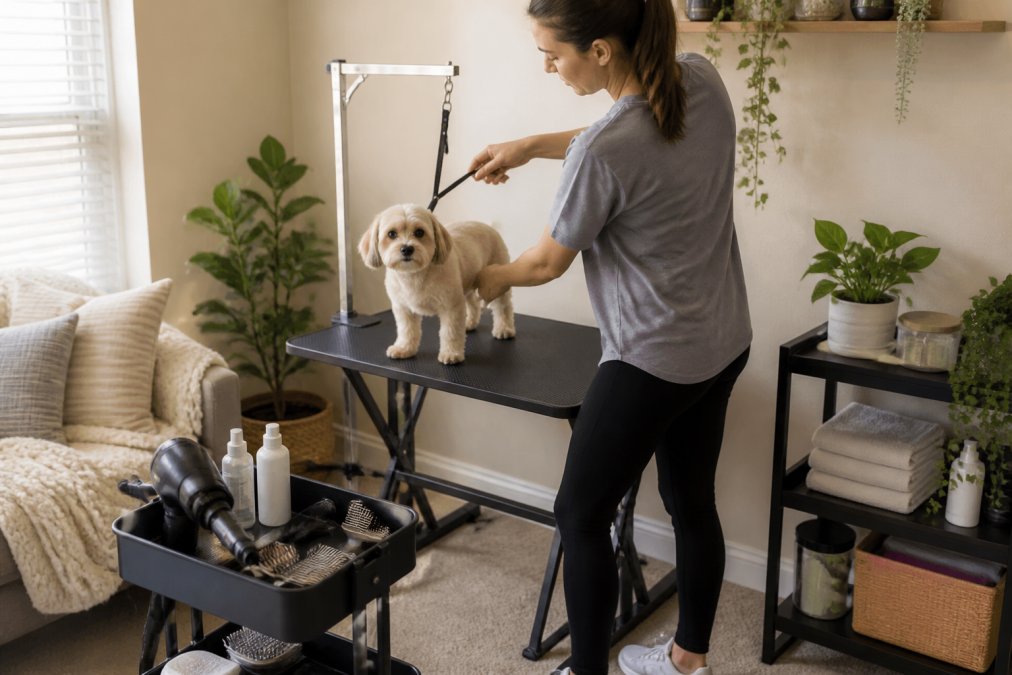
Setting up a home grooming station in a small space comes down to three decisions: where the table lives during use, where it stores between sessions, and where the mess goes. The real work is in the storage mechanics, because a table that is annoying to put away is a table you stop using.
Start with the footprint math. A typical folding table with a 36-inch by 24-inch top needs roughly a 3-foot by 2-foot clear zone during use, plus about 18 inches of walk-around space on the working side (osha.gov). Measure that zone before you buy; if you cannot clear it, a smaller top or wall-mount solution fits better.
Storage Options Ranked by Space Saved
- Upright against a wall: The default for folding tables. Fold the legs, stand the table on its short edge, and lean it in a closet or behind a door. Saves the most floor space but requires a dedicated wall.
- Under-bed or under-sofa slide: Works only if the folded table is under about 6 inches thick with no protruding hardware. Measure clearance first; most heavy-duty frames are too tall.
- Wall-mount or hook-hang: Some folding tables have a handle or bracket for heavy-duty garage hooks. Confirm the hook's weight rating exceeds the table's shipping weight with margin.
- Dedicated cart or rolling base: A locking-caster base lets you roll the table out and back without lifting. It costs floor space but saves your back.
Choosing a Folding Mechanism That Actually Folds Flat
Not all folding tables fold the same way, and the difference matters in a small home. Look for legs that fold inward and lie flush against the underside of the tabletop rather than splaying outward into a bulky triangle. A flush-fold table stores in roughly the thickness of the top plus the frame, often 3 to 5 inches; a splayed-leg table can be twice that.
Check two things before buying: whether the legs lock in both open and folded positions, and whether the lock is a positive latch or just friction. Friction locks loosen over time, which is why many owners report a table that "used to be stable." A positive latch clicks into place and stays there.
Keeping the Mess Contained
- Lay a waterproof mat under the table to catch hair and water; a lip keeps runoff from spreading.
- Keep clippers, shears, ear cleaner, and towels within arm's reach so you are not stepping away mid-groom.
- Position the table near a window or lamp for visibility, but out of direct sun so the surface does not get hot.
- Use a shop or handheld vacuum with a pet attachment rather than sweeping, which spreads hair.
Non-slip rubber matting matters more in a small setup, because you have less room to correct a slipping dog. Pair it with a properly fitted grooming loop or noose restraint that holds the dog without pulling on the throat.
Noise Reduction and Anxious Pet Considerations
Noise is the most overlooked part of home grooming, and often what sends anxious dogs over the edge. Electric actuators hum, clippers vibrate, and dryers roar. If your dog is noise-sensitive, run the table up and down while it is empty and reward calm behavior before putting the dog on it. Choose a quieter actuator where possible, and do the loudest steps, like drying, in short bursts with breaks.
Maintenance Tips for Grooming Tables: Keeping Your Investment Safe
Maintenance tips for grooming tables start with a simple habit: wipe the tabletop after every session. Hair, dander, and moisture build up fast, and a waterproof tabletop only stays waterproof if the surface and seams are cleaned rather than soaked. The habits that keep a table safe for years are tied to specific materials and mechanisms.
Match the Cleaner to the Surface
- Stainless steel tops: Wipe with mild dish soap and water, then dry. Avoid chlorine bleach and abrasive pads, which pit the surface and create crevices where bacteria collect.
- Powder-coated or painted steel frames: Wipe with a damp cloth only. Solvent cleaners and harsh degreasers strip the coating, and rust starts at the edges and welds once it is gone.
- Rubber or PVC matting: Rinse and hang to dry. Do not leave matting sitting in water; trapped moisture corrodes the top underneath.
- Plastic or composite tops: Check the manufacturer's guidance, because some composites are damaged by alcohol-based cleaners.
A Condition-Based Inspection Schedule
Inspect by condition and function:
- After every session: Wipe the top and mat, and look for new scratches or lifted edges on the matting.
- Weekly: Check the grooming arm and loop for fraying, bent hardware, or a latch that no longer holds. A slipping loop is a fall risk.
- Monthly: Tighten bolts and hinge screws, and test leg locks by pressing down on each corner. A leg that gives under pressure needs adjustment or replacement.
- Per the manufacturer's schedule: Lubricate the electric actuator or hydraulic pump, but do not over-lubricate; excess grease attracts hair and grit.
- Seasonally: Inspect welds and joints for rust, especially in a humid bathroom or garage. Surface rust can be sanded and touched up; rust at a weld is a structural warning sign.
Common Failure Modes and What They Mean
- Wobble that develops over time: Usually a loosened leg lock or worn hinge pin, not a bent frame. Tighten or replace the hardware before assuming the table is done.
- Actuator that stalls or slows: Often a power supply or load issue rather than a failed motor. Confirm the table is within its rated capacity and the outlet supplies steady power before ordering parts.
- Hydraulic pump that sinks under load: A sign of a seal or fluid issue. Stop using the table under load and have the pump serviced; a table that drops mid-groom is a serious hazard.
- Matting that curls at the edges: A trip and slip hazard. Replace the mat rather than taping it down, since tape leaves adhesive residue.
Storage and Longevity
Durability comes down to surface grip and frame. A stainless steel frame resists rust far better than painted steel in a humid bathroom, and replaceable rubber matting means a worn surface costs you a mat, not a whole table. Store folding tables dry with the legs unlocked or as the manufacturer specifies, so hinges are not held under tension for months. In a garage or shed, cover the table to keep dust and moisture off the actuator and pump.
Ergonomic Impact on the Human Groomer: Protecting Your Back and Wrists
Most buying guides treat ergonomics as a bonus. It should be the deciding factor. Grooming a medium or large dog on the floor means twenty to forty minutes of kneeling, bending, and twisting, the posture behind most of the soreness owners describe afterward.
Ergonomic design in a grooming table means three things: an adjustable height that lets you work with your elbows near your waist, a tabletop depth that keeps the dog close to your body, and a stable base so you are not bracing with your core. Adjust the table so the dog's back sits just below your elbow. For wrist protection, keep shears and clippers sharp, let the tool do the cutting, and avoid gripping the grooming arm.
The biggest ergonomic gain is not the table height but the foot pedal control. Raising the table without putting the dog down or reaching for a switch keeps the session flowing, and it is the feature owners use most once they have it.
Conclusion
Choosing among professional grooming tables for home use comes down to matching the table to your dog's weight, your space, and your own body. Get the capacity margin right, insist on wobble-free construction and non-slip matting, and pick an adjustment mechanism you will actually use.
PetzGlow offers professional-grade grooming tables and bath tubs designed to reduce the struggle of grooming, with waterproof surfaces and stable frames that make home sessions calmer for you and your dog. Shop now and turn grooming from a chore into a routine.
Frequently Asked Questions
What features should I look for in a professional grooming table?
Prioritize weight capacity, stability, and surface grip. A heavy-duty stainless steel frame with wobble-free construction prevents tipping. Look for non-slip rubber matting and a reliable grooming arm with a noose restraint. If you have a large dog, check the height adjustment range. For home use, portable folding legs and locking casters make storage easier. Noise level matters if your pet is anxious, so consider manual or hydraulic options over loud electric actuators.
Is it worth buying a professional grooming table for home use?
If you groom your dog more than once a month, a professional grooming table for home use pays for itself by reducing back strain and keeping your pet safely contained. It also cuts the mess and stress of chasing a dog around the house. For multi-pet households, the time savings add up quickly. The key is choosing a table that matches your dog's weight and your available storage space.
How do I choose the right size grooming table for my dog breed?
Measure your dog from nose to tail and add 6 to 8 inches of clearance. Tabletop dimensions should allow your pet to stand, turn around, and lie down without hanging off the edge. For small breeds, a 24 by 36 inch table works well. Medium dogs need at least 30 by 42 inches. Large breeds require 36 by 48 inches or more. Always confirm the weight limit exceeds your dog's weight by at least 20 percent.
Can I use a folding grooming table for professional-quality results at home?
Yes, if you choose one with a locking mechanism and a stable base. Portable folding legs are convenient for small homes, but they must lock securely to prevent collapse. Look for anti-vibration stabilizers and a waterproof tabletop. A folding table with a stainless steel frame and non-slip rubber matting can deliver salon-grade results. Just avoid models with flimsy hinges, as they tend to wobble during grooming.
AVMA pet ownership and veterinary care resources
CDC healthy pets, healthy people guidance
ASPCA dog grooming and coat care guidance