
Table of Contents
- Signs Your Fountain Pump Is Failing
- Submersible Fountain Pump Sizing Guide: GPH and Max Head
- How to Clean a Cat Water Fountain Pump
- Pet Water Fountain Pump Troubleshooting: Noises, Flow, and Power
- Universal Compatibility: Matching a Replacement Pump to Any Fountain
- Smart-Home Integration and Disposal After Pump Replacement
- Frequently Asked Questions
Last Updated: September 27, 2026
Signs Your Fountain Pump Is Failing
A pump replacement starts with catching the warning signs early. Most fountain pumps do not die suddenly. They fade.
Here is what usually signals the end:
- Flow rate drops even after a full clean
- The pump runs hot or shuts off on its own
- Strange rattling, buzzing, or clicking sounds
- Water backs up instead of circulating
- Visible cracks or worn impeller blades
Submersible Fountain Pump Sizing Guide: GPH and Max Head
Sizing a submersible fountain pump comes down to two numbers: GPH and max head. Get these wrong and your new pump will either sputter or overflow.
Why the rating on the box is not the flow you get
A pump rated at 150 GPH does not deliver 150 GPH once it is lifting water. Flow falls as lift rises, and it hits zero at max head. A pump with 150 GPH at 0 ft and 3 ft of max head might only move about 75 GPH at 1.5 ft of lift. That is why buying on GPH alone is the most common sizing mistake.
How to measure your fountain's actual lift
Lift is not the height of the fountain. It is the vertical distance from the water surface in the reservoir to the highest point the water exits, usually the spout or the top of the spillway.
- Fill the fountain to its normal operating level.
- Measure straight up from the water surface to the spout outlet.
- Add roughly 1 ft of head for every 10 ft of horizontal tubing run, since friction in the tube eats pressure.
- Add about 0.5 ft if the water passes through a filter or a narrow nozzle.
Matching GPH to the fountain, not just the tank
GPH should be driven by how fast the water needs to cycle, not by tank size alone. A common pattern is to aim for a full turnover every 1 to 3 minutes for drinking fountains, which keeps water moving and discourages stagnation.
| Fountain Size | Tank Capacity | Target GPH | Typical Max Head |
|---|---|---|---|
| Small (single cat) | Under 1 liter | 40-80 GPH | 1-2 ft |
| Medium | 1-2 liters | 80-150 GPH | 2-3 ft |
| Large (multi-pet) | 2-7 liters | 150-350 GPH | 3-5 ft |
Outlet and tubing: where sizing quietly fails
Match the outlet size to the tubing. A 0.33-inch outlet needs tubing of the same inner diameter. Too narrow and flow chokes; too wide and pressure drops and the stream goes lazy.
- Barbed outlets grip flexible tubing and resist slipping, the safer choice for a fountain that gets bumped.
- Threaded outlets need a matching threaded adapter; a barb forced onto a thread will leak.
- Nozzle diameter sets the visual height of the spray. A narrower nozzle throws water higher but cuts GPH, so a pump that looks oversized on paper may be right once the nozzle is factored in.
How to Clean a Cat Water Fountain Pump
Cleaning a cat water fountain pump takes about 15 minutes and prevents most failures. Do it every two to four weeks.
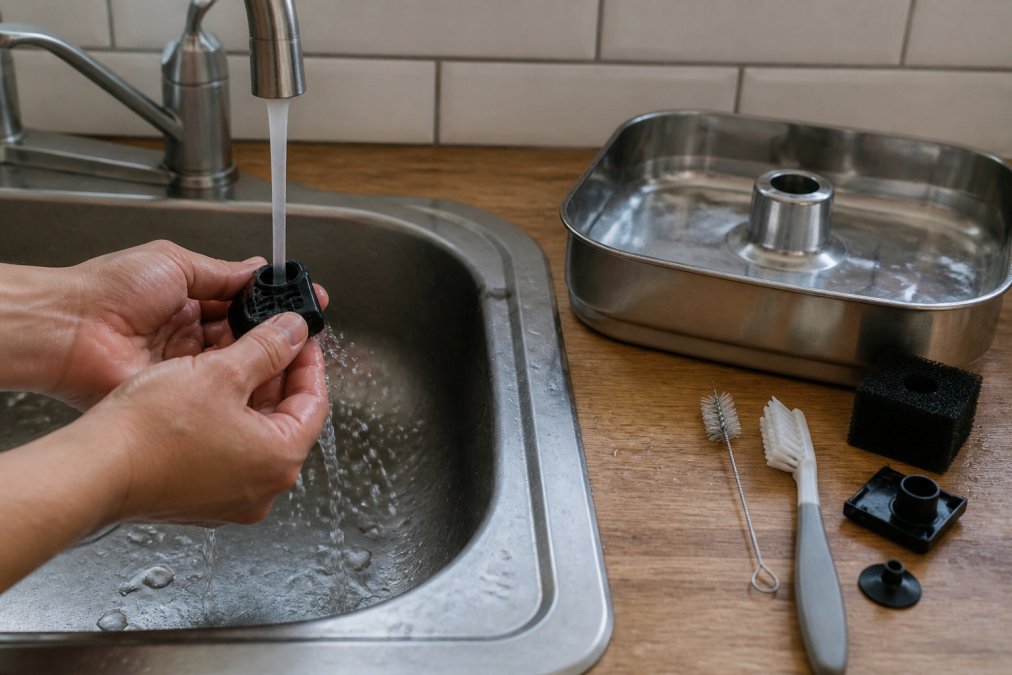
Here is the step-by-step process:
- Unplug the fountain and remove the pump from its housing
- Take off the intake screen and pull out the impeller cover
- Rinse the impeller and its cavity under warm running water
- Use a soft brush to scrub calcium buildup and slime from the blades
- Soak the pump in a 1:1 white vinegar and water mix for 20 minutes
- Rinse thoroughly and reassemble
- Run the pump in fresh water before returning it to the fountain
Pet Water Fountain Pump Troubleshooting: Noises, Flow, and Power
Pet water fountain pump troubleshooting follows a simple order: check the water, check the parts, check the power. Most problems trace back to one of those three.
| Problem | Likely Cause | Fix |
|---|---|---|
| Grinding noise | Debris in impeller | Clean and reseat impeller |
| Weak flow | Clogged screen or filter | Rinse screen, replace filter |
| No power | Wrong voltage adapter | Match 5V or 12V rating |
| Shuts off mid-run | Thermal protection trip | Refill tank, cool pump |
Universal Compatibility: Matching a Replacement Pump to Any Fountain
Most replacement guides assume you are buying the same brand again. That breaks down the moment the original pump is discontinued, the fountain is unbranded, or the manufacturer wants more for a replacement pump than the fountain cost. This section is about fitting a generic pump to any fountain by measuring the old one, the approach brand-specific guides skip.
The four specs that decide fit
Match all four and the pump will work in almost any fountain:
- Voltage and plug type: 5V USB or 12V AC. Check the label on the old adapter, not the pump.
- Outlet diameter: Measure the nozzle or barb, commonly 0.33 inch.
- Flow rate: Stay within 20% of the original GPH at operating head.
- Physical envelope: Measure the pump cavity, length, width, and height, before buying.
How to measure the old pump so a generic one fits
You do not need calipers, but they help. A ruler and a tape measure get you close enough for most fountains.
- Outlet: Measure the outside diameter of the nozzle or barb in inches. A 0.33-inch reading is the common small-pump size; 0.5 inch shows up on larger units. If the old outlet is threaded, note the thread, a barb will not seal against it.
- Cavity: Measure the inside of the pump housing where the pump sits. Leave at least 0.125 inch of clearance on each side so vibration does not rattle the pump against the wall.
- Inlet height: Note how far the intake sits below the water line. A taller replacement pump can pull air if the reservoir runs low.
- Cord length and exit point: Measure the cord and note where it exits the housing. A short cord forces an extension, which is a safety problem near water.
Reading a product listing like a fitment spec
A generic pump listing that is worth buying will state voltage, GPH, max head, outlet diameter, and physical dimensions. If any of those is missing, skip it, you cannot confirm fit without them.
- Voltage mismatch is the one that destroys pumps. A 5V USB pump on a 12V AC adapter will overheat and fail. A 12V pump on a 5V supply will hum and not spin. They are not interchangeable.
- Outlet adapters are the workaround when diameters are close but not exact. A stepped adapter set lets a 0.33-inch pump feed 0.5-inch tubing, but it adds a little head loss, factor that into sizing.
- Flow within 20% keeps the fountain from overflowing or starving. Going far above the original GPH can overwhelm the spillway; going far below leaves the stream weak.
When nothing matches exactly
If the cavity is too small for any pump that meets your GPH target, the practical options are to step down in flow and accept a gentler stream, or to run the pump outside the housing with the intake screened and submerged. The second option works but exposes the pump to more debris, so plan on more frequent cleaning.
Smart-Home Integration and Disposal After Pump Replacement
Smart-home integration is now possible for fountain pumps. Plug-in smart outlets let you schedule run times and monitor power draw. Some models pair with water-level sensors that alert you when the tank runs low.
Frequently Asked Questions
How do I choose the right size fountain pump for my fountain?
Match the pump's gallons per hour (GPH) rating to your fountain's capacity and lift height. Check the old pump's label first, then confirm the outlet diameter and voltage. In a submersible fountain pump sizing guide, the rule is simple: higher max head means less flow at the top. Measure the vertical distance from the pump to the spout, add a little extra for tubing bends, and pick a pump rated above that number.
What are common mistakes in water pump replacement?
The most frequent errors are buying a pump with the wrong outlet size, ignoring voltage compatibility, and skipping the intake screen check. A pump that is too strong can splash water out of the basin; one that is too weak barely moves it. Always unplug the fountain before you start, keep the old pump for reference, and test the new one in water before closing the housing.
How long do fountain water pumps last?
Most submersible pumps run 1.5 to 3 years with regular cleaning. Hard water speeds up calcium buildup on the impeller, which shortens pump longevity. Rinsing the intake screen weekly and descaling monthly can push a pump toward the longer end. If flow drops even after cleaning, or the pump rattles, it is usually time for a replacement.
Can I use any pump for my pet water fountain?
Not always. Voltage compatibility, outlet diameter, and physical size must all match. A 5V USB pump cannot replace a 12V AC pump without the right adapter, and a pump that is too tall will not fit the housing. Measure the old pump, note the voltage and GPH, and choose a replacement that matches or slightly exceeds those numbers. PetzGlow offers fountains with low-voltage pumps rated under 35dB.
Replacing a fountain pump is a small job with a big payoff. The right specs, a clean impeller, and a quiet motor keep water flowing for years. At PetzGlow, we build fountains with ultra-quiet pump technology, high-capacity tanks, and easy-to-clean stainless steel. Shop now and give your pets fresh, quiet hydration every day.