
Table of Contents
- Why Dogs Fear Grooming Tables: The Core Triggers
- Signs of Stress in Dogs During Grooming Sessions
- How to Desensitize Your Dog to Grooming Tables: A Step-by-Step Plan
- How to Trim Dog Nails Without Stress: Practical Techniques
- Safe Restraint and Fall Prevention on Grooming Tables
- Home Grooming Tables vs. Professional Grooming: What's the Difference
- Recognizing Escalation: When to Stop and Seek Help
- Frequently Asked Questions
Last Updated: October 5, 2026
Why Dogs Fear Grooming Tables: The Core Triggers
Dogs often experience real anxiety around grooming tables, and the causes are predictable.
Your dog isn't being difficult, the table, height, restraint, and vulnerability create a perfect storm of legitimate triggers.
Unfamiliar Handling and Vulnerable Positioning
Being lifted onto a raised platform puts your dog in an unfamiliar, vulnerable position: paws off the ground, no control, no easy escape.
That triggers an instinctive stress response, and restraint loops add another layer, even gentle handling feels threatening when your dog is elevated and confined.
Slippery Surfaces and Fear of Falling
Most grooming table surfaces are smooth or have minimal traction, so paws slip.

Without firm footing, every small movement feels risky.
A nonslip rubber surface makes an enormous difference. The American Veterinary Medical Association guidance on grooming safety emphasizes that secure footing reduces stress significantly. Dogs with proper traction show measurably calmer behavior.
Sensitivity Around Paws, Face, and Ears
Certain body areas are naturally sensitive: paws have concentrated nerve endings, and the face and ears are vulnerable.
When a groomer approaches these areas, defensive instincts activate, vulnerability plus handling in sensitive zones is a perfect anxiety trigger.
Signs of Stress in Dogs During Grooming Sessions
Recognizing stress signals early lets you intervene before anxiety escalates.
Body Language That Signals Distress
Watch for these specific signs:
- Ears pinned back or forward rigidly
- Tail tucked tightly or held stiffly
- Trembling or shaking
These signals mean your dog is uncomfortable. They're not ready for grooming at this intensity. Pushing through causes lasting negative associations.
When Stress Becomes a Medical Concern
Sometimes what looks like grooming anxiety is actually pain from a skin condition, joint problem, or injury.
Rule out medical issues first. A vet can check for:
- Skin allergies or infections
- Ear infections or sensitivity
- Joint pain or arthritis
If your vet clears medical problems, you're dealing with genuine grooming table anxiety, and desensitization becomes your strategy.
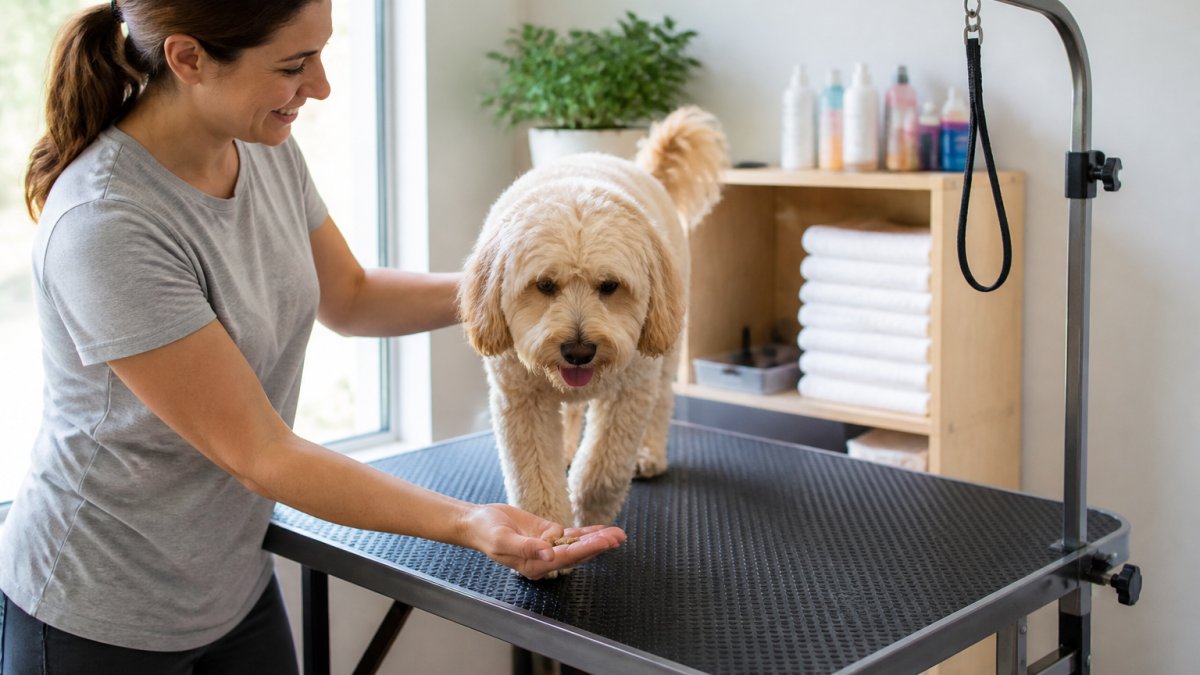
How to Desensitize Your Dog to Grooming Tables: A Step-by-Step Plan
Desensitization works. It takes patience and consistency, but most dogs improve within 2-3 weeks of regular practice.
Move slowly, each phase builds on the previous one.
Phase 1: Introduction Without Restraint
Start with zero pressure: make the table feel safe.
Here's what to do:
- Place the table in a familiar room where your dog spends time
- Leave it there for several days without using it
- Reward your dog for being near it (treats, praise, toys)
- Encourage your dog to sniff and investigate
- Place treats on and around the table
- Let your dog approach at their own pace
This phase has no timeline. Some dogs need a week. Others need three. Your dog dictates the pace.
Phase 2: Gradual Touch and Handling
Once your dog approaches the table willingly, introduce gentle contact.
Start here:
- Have your dog stand next to the table (not on it yet)
- Touch their paws gently while offering treats
- Touch their face and ears while praising
- Gradually increase the duration of touch
- Move closer to the table during these touches
- Reward heavily for calm behavior
Phase 3: Short Grooming Sessions With Positive Reinforcement
Only after your dog is comfortable with touch should you attempt actual grooming.
Follow this structure:
- Keep sessions to 5-10 minutes maximum
- Focus on one body area per session
- Use high-value treats (small pieces of chicken, cheese)
- Praise constantly during grooming
- Stop before your dog shows stress
- End on a positive note every single time
Ending before stress appears is critical: your dog should finish each session thinking, "That wasn't so bad."
How to Trim Dog Nails Without Stress: Practical Techniques
Nail trimming is often the most anxiety-inducing grooming task: paws are sensitive, clippers make noise, and the experience feels invasive.
Choosing the Right Equipment and Setup
Get these items:
- Quiet nail clippers (scissor-style or grinder with low noise)
- Nonslip mat for the grooming table
- High-value treats (cut into tiny pieces)
A veterinary grooming resource from the International Association of Canine Professionals recommends quiet equipment specifically because noise amplifies anxiety in already-stressed dogs.
The PawHut 42" Dog Grooming Table with adjustable height and nonslip rubber top gives you the stable, quiet environment nails require, and the rubber surface prevents slipping during this vulnerable task.
Building Tolerance for Paw Handling
Paw sensitivity is learned, not innate, and gradual exposure can change it.
PawHut 42" Dog Grooming Table, Adjustable Pet Cat Drying Beauty Table With 2 →
Practice this daily:
- Hold your dog's paw gently for 2-3 seconds
- Release and reward immediately
- Gradually increase hold duration
- Touch between the toes
- Apply light pressure to each nail
- Eventually, handle with clippers (without cutting)
Do this away from the table first, in a safe, familiar space. Only move to the table once paw handling feels routine.
Safe Restraint and Fall Prevention on Grooming Tables
Most articles tell you to "use a loop and a nonslip mat." That's not enough, the table is the one piece of grooming equipment where a mistake can cause a fall injury. Here's how restraint works on a dog's nervous system, how to set table height, and how to prevent falls.
Why Restraint Cuts Both Ways
A grooming loop or belly sling limits movement, which can feel like a steadying hand but also removes the dog's ability to flee. For a dog already worried about the height, that loss of control is the trigger, not the fix.
The difference is almost always tension and fit, not the loop itself:
- A loop that sits high and tight pulls the throat upward and signals "I can't get away." That reads as a threat.
- A loop that sits low and loose, with the dog able to stand, sit, and turn its head naturally, reads as a boundary rather than a trap.
- A belly sling that supports the rear legs is different from a neck loop. It prevents a dog from sitting or lying down mid-groom, which is useful for senior dogs or dogs with rear-leg weakness, but it should never be the only restraint on a dog that is panicking.
A common practitioner rule is the two-finger check: you should slide two fingers flat between the loop and the dog's neck without forcing.
Setting Table Height and Footing
Table height is the variable most owners never think about, and it most affects fall risk.
- Work at your waist, not your shoulders. A table that's too high forces you to pull the dog toward you, off-balancing you both; too low makes you hunch and lose control of the front end. Adjustable-height tables exist for this reason.
- Match the surface to the dog's nails. A smooth laminate top is the worst case for long nails; a rubberized nonslip mat with a raised nub pattern gives paws something to grip. If your dog still slides, the mat is too thin or the wrong material.
- Never leave a looped dog unattended. A dog that panics in a loop can strangle or fall off the table in seconds. If you must step away, unclip the loop and put the dog on the floor.
Never use a choke chain, prong collar, or a loop attached to a collar with a buckle as a grooming restraint. If the dog lunges or the table tips, the collar can tighten or the buckle can fail. Use a purpose-built grooming loop or a belly sling rated for the dog's weight.

A Fall-Prevention Checklist
Run through this before every session:
- Table legs locked and level, no wobble when you press down on one corner.
- Nonslip mat seated flat, no curled edges the dog can catch a nail on.
- Loop fitted with the two-finger check, positioned low on the neck.
- Dog's collar removed or tucked so nothing can snag on the loop hardware.
- All tools within arm's reach so you never turn your back.
- A second person present for the first few sessions with a large or strong dog.
- A soft landing zone, a rug or mat on the floor beneath the table, in case of a slip.
If your dog has ever jumped or fallen from a table, start over. A single fall can install a fear that outlasts months of positive handling, and the fix is slower, lower, and closer to the ground than you think.
Home Grooming Tables vs. Professional Grooming: What's the Difference
"My dog is fine at home but loses it at the groomer" is one of the most common patterns owners report, and the reverse happens too. The reason usually isn't the groomer or the dog, but five specific differences between the setups, any one of which can be the trigger.
The Five Differences That Actually Matter
1. Table height and stability. Home tables are often shorter and lighter, sometimes with folding legs that flex under a struggling dog; salon tables are taller, heavier, and braced.

2. Restraint style. At home, most owners use a single neck loop, if anything.
**3.
4. Smell and social load. Salons carry the scent of dozens of unfamiliar dogs, plus shampoos, conditioners, and cleaning products.
5. Session length and pace. A salon groomer works to a schedule; a home session can stop the moment the dog shows stress.
Which Setup Fits Which Dog
Use the differences above as a diagnostic, not a verdict. Ask: which of the five is my dog reacting to?
- If your dog is fine on a stable table at home but panics in the salon, the trigger is likely sound, scent, or restraint style, not the table itself.
- If your dog panics on any raised surface, including a stable home table, the trigger is height and footing.
- If your dog is fine until the groomer touches the paws or face, the trigger is handling, not the table.
Film a short session at home and, if your groomer allows it, ask them to describe what your dog does in the salon. Comparing the two tells you which of the five differences is doing the damage.
When Professional Help Is the Right Call
Professional grooming isn't a failure of home training, and home grooming isn't always a substitute. Consider a professional when:
- Your dog's coat is matted close to the skin. Dematting at home with dull tools causes pain and can turn a manageable dog into a bite risk.
- Your dog's nails are overgrown to the point that the quick has extended. A groomer or vet tech can take them back safely over several visits.
- Your dog has escalated to snapping, growling, or biting. That's a safety issue, not a training issue, and it needs a force-free professional.
When you go professional, tell the groomer what you've observed at home, which of the five differences sets your dog off, what treats work, and how long your dog tolerates handling before showing stress. A good groomer will adjust pace and restraint accordingly; if a groomer won't discuss it, find a different one.
Recognizing Escalation: When to Stop and Seek Help
Know when to pause. Pushing through escalating anxiety teaches your dog that their signals don't matter.
Stop immediately if your dog:
- Snaps or shows teeth
- Growls or snarls
- Attempts to bite
These signals mean you've exceeded your dog's tolerance. Continuing damages your relationship and worsens future anxiety.
When escalation happens:
- Stop the grooming session immediately
- Remove any restraints calmly
- Give your dog space to decompress
- Consult your vet to rule out pain or medical issues
- Consider working with a certified professional dog trainer
- Go back to earlier phases of desensitization
Escalation doesn't mean your dog is broken, it means your approach needs adjustment.
Grooming table anxiety is real, but it's manageable.
| Phase | Duration | Focus | Success Signal |
|---|---|---|---|
| Phase 1: Introduction | 1-3 weeks | Table familiarity | Dog approaches willingly |
| Phase 2: Touch | 1-2 weeks | Paw and face handling | Dog stays calm during touch |
| Phase 3: Grooming | 2-4 weeks | Short sessions | Dog tolerates 10-minute sessions |
Frequently Asked Questions
Why does my dog freeze up on the grooming table?
Freezing is a common fear response to unfamiliar environments, restraint, and vulnerability. Dogs may freeze when they feel trapped or uncertain, especially if the table surface feels unstable or slippery. This is often combined with anxiety about handling, particularly around sensitive areas like paws and ears. Freezing doesn't always mean your dog is calm, it can signal fear or uncertainty. Gradual desensitization with positive reinforcement and nonslip surfaces helps your dog feel secure and confident on the grooming table over time.
How can I make my dog feel safer during home grooming?
Create a calm, familiar environment and invest in a quality grooming table with a nonslip rubber top and proper restraint loops for safety. Start with short sessions (5-10 minutes) and use high-value treats and praise to build positive associations. Keep sounds and handling gentle, and never force your dog into grooming. A table like the PawHut 42" Grooming Table with its nonslip rubber tabletop and adjustable height helps reduce physical stress. Allow your dog to step on and off the table freely at first, then gradually introduce handling and grooming tools. Consistency and patience are key.
What can I use instead of a dog grooming table?
While a dedicated grooming table is ideal for safety and comfort, alternatives include a sturdy, elevated platform (like a deck or low stage), a bathtub with a nonslip mat, or even a large, stable bench with cushioning. However, these lack the safety features of a proper grooming table, such as restraint loops, adjustable height, and nonslip surfaces designed for grooming. A professional grooming table like the PawHut or portable models available through PetzGlow provides proper support, reduces fall risk, and makes grooming easier for both you and your dog. For anxious dogs, a dedicated table with familiar, consistent setup helps reduce stress over time.
How do I know if my dog's fear is actually pain or a medical issue?
Fear and pain can look similar, but there are key differences. Fear typically appears as avoidance, trembling, or freezing in response to the grooming environment or handling. Pain is often localized, your dog may flinch when a specific area (paw, ear, or spot on the body) is touched, or show signs like limping, excessive licking, or sensitivity that persists even at home. If your dog shows sudden changes in behavior, excessive sensitivity to touch, or pain signs outside of grooming, consult your veterinarian to rule out injury, skin conditions, or underlying health issues before assuming it's purely behavioral anxiety.