
Table of Contents
- Why Do Pet Fountains Make Noise? Start With the Sound
- Why Do Pet Fountains Make Noise? Start With the Sound
- Gurgling or Trickling: Air in the Line
- Humming, Buzzing, or Rattling: Motor and Vibration
- Low Water Levels and Airlocks: The Two Fastest Fixes
- How to Clean a Cat Water Fountain Pump (Step by Step)
- Mineral Buildup, Debris, and Water Chemistry
- Quieting Vibration and Mechanical Noise
- Repair or Replace the Pump? A Simple Decision
- Best Quiet Water Fountains for Cats and Multi-Pet Homes
- Conclusion
- Frequently Asked Questions
Last Updated: September 23, 2026
Why Do Pet Fountains Make Noise? Start With the Sound
Most pet fountains are not broken. They are just telling you something. If you have ever stood in your kitchen wondering why do pet fountains make noise at 2 a.m., the answer is usually one of a handful of fixable problems: trapped air, low water, grit in the pump, or a loose part rattling against the bowl.
Why Do Pet Fountains Make Noise? Start With the Sound
The type of noise tells you where to look first. Gurgling and trickling come from air or low water. Humming, buzzing, and rattling come from the motor or from vibration. Learning to tell these apart saves you from taking apart a pump that was never the problem.
| Sound | Most Likely Cause | First Fix |
|---|---|---|
| Gurgling, trickling | Airlock or low water | Top off and prime the pump |
| Humming, buzzing | Motor strain or debris | Clean the impeller |
| Rattling | Loose part or vibration | Check suction cups and housing |
| Grinding | Mineral deposits | Descale the pump |
Gurgling or Trickling: Air in the Line
Gurgling is almost always air. When air gets pulled into the intake, the pump pushes a mix of water and bubbles, and you hear that sputtering, trickling sound. It is the single most common cause of a noisy fountain.
Humming, Buzzing, or Rattling: Motor and Vibration
A steady hum is normal. A loud buzz is not. When the hum turns into a buzz, the motor is working harder than it should. That usually means the impeller is clogged with hair or debris, or the pump is not getting enough water.
Try these steps:
- Press the pump firmly onto the basin floor
- Check that all suction cups are attached and clean
- Make sure the pump is not resting against the bowl wall
- Remove the top housing and reseat it
Low Water Levels and Airlocks: The Two Fastest Fixes
Low water and airlocks cause most fountain noise, and both take seconds to fix. Before you clean anything, check the water level and prime the pump.
How to Prime the Pump and Clear an Airlock
Priming means filling the pump with water before it runs. Here is how:
- Unplug the fountain and remove the pump.
- Hold the pump underwater and tilt it gently until bubbles stop rising.
- Set the pump back in the basin, fully submerged.
- Plug it in and let it run for two to three minutes.
How to Clean a Cat Water Fountain Pump (Step by Step)
Cleaning the pump is the most reliable fix for a noisy fountain. If you want to know how to clean cat water fountain pump parts properly, the process takes about 15 minutes and needs no special tools.
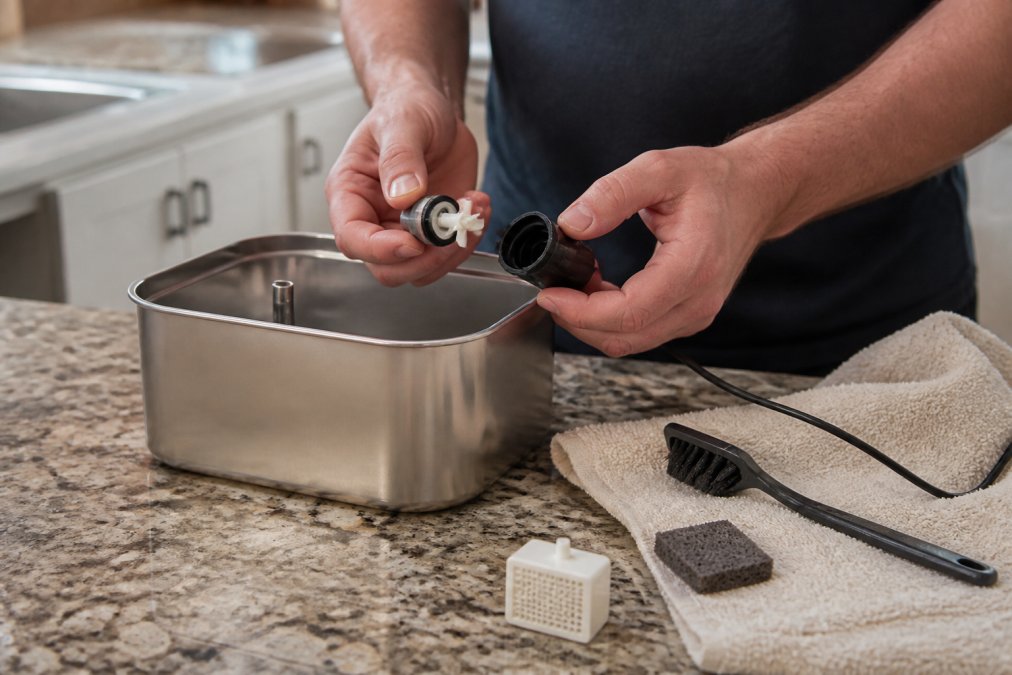
- Unplug the fountain. Never clean a pump while it is plugged in.
- Remove the pump and filter. Set them on a towel.
- Take the pump apart. Twist off the front cover to expose the impeller.
- Pull out hair and debris. Use your fingers or a small brush.
- Rinse the impeller and shaft. Warm water is enough for routine cleaning.
- Scrub the basin and spout. A soft brush reaches the corners.
- Reassemble and refill. Prime the pump before plugging it back in.
How Often to Clean the Pump, Filter, and Reservoir
| Part | How Often | Why It Matters |
|---|---|---|
| Pump and impeller | Every 2 weeks | Stops buzzing and grinding |
| Filter | Every 2-4 weeks | Keeps hair out of the pump |
| Full reservoir scrub | Every 2 weeks | Removes slime and residue |
| Deep descale | Monthly | Clears mineral deposits |
In a multi-pet home, cut those intervals in half. More pets means more hair and more saliva in the water.
Mineral Buildup, Debris, and Water Chemistry
Hard water leaves mineral deposits on the impeller and shaft. Over time, that calcium buildup makes the impeller wobble, and a wobbling impeller buzzes. This is the cause most owners never think to check.
Water Fountain Stainless Steel, 108oz →
Quieting Vibration and Mechanical Noise
Here is how the common dampening materials compare:
| Material | Best For | Trade-off |
|---|---|---|
| Silicone mat (1/8 to 1/4 inch) | Hard tile, stone, laminate | Resists water and stays put; slightly firmer than foam |
| Closed-cell foam pad | Carpeted or wood floors | Cheap and effective; degrades faster when wet |
| Cork coaster or trivet | Small fountains, desks | Natural look; can mold if it stays damp |
| Folded microfiber towel | Quick test before buying a mat | Absorbs vibration well; needs frequent washing |
| Rubber furniture foot pads | Isolating the pump inside the basin | Tiny footprint; only helps if the pump itself is the source |
- Keep the fountain off hollow surfaces like thin metal, glass, or a hollow-core door used as a table.
- Move it away from bare walls and hard corners, which reflect and concentrate sound.
- Set it on a low, dense surface rather than a high, resonant one.
- Check that the pump is not touching the basin sides, the spout, or the housing.
One more mechanism worth knowing: loose parts rattle at a different pitch than a hum. A hum is a steady tone from the motor. A rattle is intermittent and sharp, and it usually means a suction cup lost its grip, the housing is not seated, or a small piece of plastic is vibrating against the bowl. Press the pump firmly onto the basin floor, reseat the housing, and confirm every suction cup is attached and clean before you assume the motor is failing.
Repair or Replace the Pump? A Simple Decision
Most guides tell you to replace the pump when it gets loud. That advice is expensive and often wrong. A pump is usually salvageable unless the motor or impeller is physically worn, and the two are easy to tell apart once you know what to look for.
Use this decision matrix before you buy anything:
| Signal | Likely Verdict | Why |
|---|---|---|
| Noise started recently and cleaning quiets it | Repair | Debris or air, not wear |
| Buzz returns within days of every cleaning | Replace | Impeller or shaft is worn |
| Flow rate has dropped noticeably | Replace | Motor is losing power |
| Visible cracks in the housing | Replace | Housing cannot seal or hold the impeller |
| Pump runs but makes no water movement | Replace | Motor is seized or burned out |
| Grinding that continues after descaling | Replace | Mineral damage to the impeller bore |
| Pump is quiet but rattles | Repair | Loose mount or suction cup, not the motor |
| Pump is over 18 to 24 months old and noisy | Lean replace | Motors wear with runtime, not just use |
A few trade-offs to weigh before deciding:
- Effort: A cleaning and descale takes about 15 minutes and costs nothing but vinegar and water. A replacement pump is a 5-minute swap but requires ordering the right model.
- Cost: A replacement pump is almost always cheaper than a new fountain, so replacing the pump is the low-cost path when the motor is actually worn.
- Compatibility: Match the pump's flow rate, voltage, and fitting size to the original. A pump that is too strong can overflow the basin; one that is too weak will not push water through the filter.
- Warranty: Check the fountain's warranty before you open the pump housing. Some manufacturers void coverage if the pump has been disassembled.
Best Quiet Water Fountains for Cats and Multi-Pet Homes
The best quiet water fountains for cats use a low-noise pump and a design that keeps the intake submerged. Pump quality matters more than bowl shape.
Conclusion
Fountain noise is a signal, not a sentence. Match the sound to its cause, and most fixes take under 15 minutes.
Frequently Asked Questions
Why is my cat fountain making noise?
Most pet fountains noise comes down to four things: air trapped in the pump (airlock), a low water level, debris or hair wrapped around the impeller, or mineral deposits on the impeller shaft. Gurgling points to air; humming or rattling points to the motor or vibration against the bowl. Check the water level first, then prime the pump, then clean the impeller. Most noises stop after those three steps.
How do I make a cat water fountain quieter?
Run the fountain at or above its minimum fill line, since a low reservoir amplifies trickling and pump hum. Set the fountain on a silicone mat or thin foam pad to absorb vibration, and keep it away from cabinet sides and walls that reflect sound. Clean the impeller and shaft every two weeks. If the pump still hums after cleaning, it is usually worn out and a replacement pump is the cheapest fix.
Can low water levels cause a pet fountain to make noise?
Yes. When the water drops below the intake, the pump pulls air instead of water, which produces loud gurgling, sputtering, and a strained motor hum. Topping off the reservoir usually silences it within a minute. A fountain with a water level window makes this easy to check without lifting the lid, so you can see when it is time to refill before the noise starts.
How often should I clean my pet's water fountain pump?
Rinse the pump and impeller every two weeks, and do a full descaling soak once a month if your tap water is hard. Hair, food particles, and calcium buildup are the three most common causes of a noisy or clogged pump. A small cleaning brush reaches the impeller housing and intake slots. If your cat has long hair or you have multiple pets, clean weekly instead.