
Table of Contents
- Why Anxious Dogs Struggle With Grooming at Home
- Set Up a Fear-Free Grooming Space Before You Start
- Desensitization Techniques for Dog Grooming That Work
- Best Grooming Tools for Nervous Dogs
- How to Trim Dog Nails Without Stress
- Emergency Stop Signals and When to Call a Professional
- Conclusion
- Frequently Asked Questions
Last Updated: September 15, 2026
Why Anxious Dogs Struggle With Grooming at Home
Most dogs aren't difficult. They're scared, and the home grooming setup usually makes it worse, which is why learning how to groom anxious dogs at home matters so much. Learning how to groom anxious dogs at home starts with understanding that anxiety isn't stubbornness; it's a stress response to handling, noise, and restraint. At PetzGlow, we hear from owners every week whose dogs tremble the moment clippers appear.
Dogs communicate fear before they panic. The American Veterinary Medical Association's pet owner resources notes that subtle signals like lip licking, yawning, and turning away are early distress cues owners routinely miss. Miss them often enough and a nervous dog becomes a defensive one.
Reading Calming Signals and Stress Thresholds
Calming signals are the small, polite gestures dogs use to say "I'm uncomfortable" before fear escalates. Whale eye, lip licking, and freezing are warnings, not misbehavior.
Every dog has a stress threshold, the point where learning stops and reaction takes over. Cross it and treats stop working, handling becomes a fight, and the session ends badly for both of you. The goal of home grooming is simple: stay under that threshold, every single time.
Set Up a Fear-Free Grooming Space Before You Start
A fear-free setup means controlling the sensory environment before your dog enters it. Nonslip surfaces, soft lighting, and no other pets in the room reduce baseline arousal before you pick up a single tool.
What most guides miss is that dogs read the room faster than they read you. A cluttered bathroom with a running dryer sets the tone before grooming begins. Set up first, bring the dog in second.
- Work on a nonslip mat or a stable grooming table, never a slippery tub floor
- Play calming music at low volume to mask clipper noise
- Keep treats, towels, and tools within arm's reach so you never leave mid-session
- Groom in short sessions at the same time of day to build a predictable routine
Consistency matters more than equipment. A predictable routine lowers anxiety over weeks, not minutes.
Desensitization Techniques for Dog Grooming That Work
Desensitization techniques for dog grooming work by pairing scary sensations with things your dog loves, slowly enough that fear never spikes. The method has two halves: desensitization (gentle exposure at a level your dog can tolerate) and counter-conditioning (changing the emotional response to the trigger). Most guides describe the idea and stop there. What actually decides whether home grooming works is the schedule you follow, so here is a concrete one.
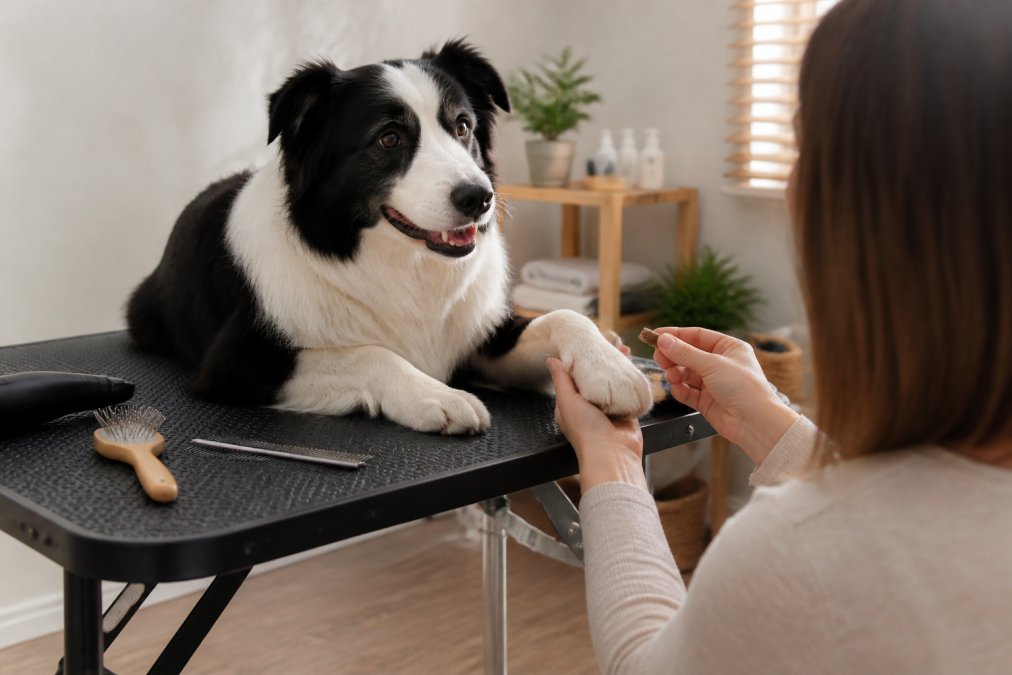
The Three-Phase Progression
Every tool follows the same three phases, and you do not advance until your dog is relaxed at the current phase for two or three sessions in a row.
- Presence. Tool sits on the floor, switched off, several feet away. Treat, then put it away. Repeat until the tool's appearance predicts a treat rather than a chase.
- Contact. Tool touches a neutral body part (shoulder, back) for one second, switched off. Treat, remove, end. Build to five seconds of contact across several days.
- Activation. Turn the tool on away from your dog, then near your dog, then touching fur for one to two seconds. Treat during the sound, not after it stops.
This is the part owners skip, and it's the part that decides whether the whole process works.
Tool-Specific Protocols
Different tools trigger different fears, so the schedule differs by tool.
Clippers. The blade vibration and the buzz are separate triggers. Desensitize the sound first with the clippers running in another room, then in the same room, then against your dog's body while switched off, and only then switched on. A common pattern is two to three weeks of daily two-minute sessions before the first real trim (avma.org).
Nail grinder. The rotating drum and the pressure on the nail are distinct. Let your dog hear the grinder on low speed, then touch the side of the drum to a nail for under a second, then work the tip. Many dogs tolerate a grinder faster than clippers because there is no sudden snap, but the sound is higher-pitched and some dogs find it worse. Test both and follow your dog.
Brush and comb. Work in one-inch sections, treat after each section, and stop before your dog pulls away. If your dog only tolerates brushing in tiny doses, a massage comb lets you do a few strokes and stop without a full grooming session.

Bath and dryer. Water and forced air are the hardest triggers to counter-condition because you cannot easily deliver a treat mid-soak. Use a nonslip mat, lukewarm water, and a cup rather than a sprayer at first. For the dryer, start on the lowest setting at arm's length and treat between passes, not during them.
Counter-Conditioning With High-Value Treats
Counter-conditioning means pairing the scary thing with something better than scary. A high-value treat, real chicken or cheese, not a dry biscuit, appears the moment the clipper touches fur and disappears when it lifts.
Timing is everything. The treat must arrive during or immediately after the trigger, not minutes later. Done consistently, many owners find their dog starts looking at the clippers instead of fleeing them. That's the shift you're after.
Session Length and Stopping Rules
Keep sessions to two to five minutes during the desensitization phase. End every session while your dog is still relaxed, not when they have had enough. A session that ends on a calm note is worth more than a longer one that ends in a flinch. If your dog refuses the treat, that is the signal to stop, because a dog over threshold will not eat.
Best Grooming Tools for Nervous Dogs
The best grooming tools for nervous dogs are quiet, stable, and gentle on skin, because noise and slipping surfaces drive most grooming fear. You don't need a full professional kit. You need a few tools that don't spook your dog.
A stable grooming table with a nonslip surface removes the scrambling that triggers panic. For coat care between sessions, a self-cleaning slicker brush removes loose fur without the yanking that makes sensitive dogs flinch, and the one-click release means you're not picking hair out of bristles while your dog waits and worries.

| Tool | What It's For | Why It Suits Anxious Dogs |
|---|---|---|
| Slicker brush | Loose fur, light mats | Gentle pins, self-cleaning |
| Round-handle comb | Detangling, finishing | Rounded teeth, no skin scrape |
| Nail clippers or grinder | Nail trimming | Quiet grinder beats loud snap |
| Nonslip mat or table | Stability | Stops scrambling and slipping |
Add a steam grooming brush for detangling without pulling, and a massage comb for dogs who accept brushing only in tiny doses. Quiet tools aren't a luxury for a fearful dog. They're the difference between a session that builds trust and one that erases it.

How to Trim Dog Nails Without Stress
Trimming one nail per session beats trimming all four paws in one sitting. That's the core rule for how to trim dog nails without stress: short, frequent, and always ending on a win.
Work in this order:
- Handle each paw for a few seconds, treat, release
Emergency Stop Signals and When to Call a Professional
Reading Calming Signals Before Fear Escalates
Managing Your Own Anxiety
Calming Aids: What to Know Before You Try Them
When to Call a Professional
Conclusion
Frequently Asked Questions
How do you calm a nervous dog before grooming?
Start 10-15 minutes before the session. Take your dog for a short sniff walk, then settle them in the grooming area with calming music and a favorite blanket. Offer high-value treats before picking up any tool so the space predicts good things. Keep your own movements slow and your voice low. If your dog is still panting, lip licking, or showing whale eye, postpone the session and try again tomorrow.
What are the best grooming tools for nervous dogs?
Look for quiet clippers, a non-slip grooming table, and brushes with rounded pin tips. A self-cleaning slicker brush like the PetzGlow Self-Cleaning Dog Brush ($15.99) lets you remove fur with one click, so your dog spends less time standing still. For sensitive coats, the Round Handle Pet Passage Comb ($30.82) has 135-degree needles that glide without scratching skin. Always introduce each tool with treats before using it.
Is it better to groom an anxious dog in short sessions?
Yes. Most behaviorists recommend 5-10 minute sessions at first, ending while your dog is still calm. Short sessions keep your dog under their stress threshold, which is the point where fear takes over and learning stops. You can build up to 20-30 minutes over several weeks. One full groom may take three or four short sessions at the start, and that is fine.
What should I do if my dog is too stressed to be groomed?
Stop the session immediately. Signs like growling, snapping, freezing, or trying to bite mean your dog has passed their stress threshold. Give them space, then contact your veterinarian to rule out pain or a medical issue. Your vet may suggest a fear-free certified groomer or a behavior consult. Forcing a groom at this point can make the fear worse and lead to aggressive behavior.